Sustainable building materials, part 3: Hemp as a building material with potential
21. April 2026
4 Mins read
Hemp as a building material? When people hear hemp, they usually think of narcotics. But cannabis, one of the oldest useful plants in the world, can also be used in other ways. Due to their high protein content, hemp seeds and oils are playing an increasingly important role in nutrition, while the flowers are used in medicine. Hemp fibers, which were used thousands of years ago to make ropes, cables and canvas, are still being used today to produce fabrics.
The fibers, which are among the strongest plant fibers in the world, can also be found in cellulose, paper and natural fiber-reinforced plastics. Hemp is also increasingly being used as a building material: The fibers are processed into insulating materials, hemp straw and wood in turn into hemp bricks, also known as hempcrete or hemp lime. “You can cover all areas of life with hemp,” says Werner Schönthaler, who has been focusing on the production of hemp blocks for 15 years.
Is hemp a sustainable building material?
Hemp is a particularly sustainable building material for several reasons. Firstly, it is a renewable, fast-growing resource. Depending on the variety and conditions, hemp can grow up to five centimetres a day and reach up to four, sometimes six, meters in height. “The biomass required for a detached house can grow on one hectare within five months,” says Schönthaler. Secondly, hemp requires hardly any fertilizer or pesticides and can be grown up to 1,900 metres above sea level. “This means it is available regionally and could contribute to Europe’s self-sufficiency in times of resource scarcity,” the hemp building block expert is convinced.
Another plus point is the fact that hemp binds carbon during growth and only a small amount of energy is required to produce the building materials. “This means it is CO2-negative,” says Schönthaler. Last but not least, hemp building materials are very durable, 100 percent recyclable and energy-efficient. “Their thermal insulation value is high and makes additional insulation superfluous. With a 38-centimetre-thick wall made of hemp blocks, you can achieve a U-value of 0.18. With 44-centimetre-thick hemp blocks, you can build a passive house,” explains Schönthaler. Due to its high storage mass, it also has a temperature-regulating effect – thus reducing energy consumption for heating and cooling.
What are the advantages of hemp as a building material?
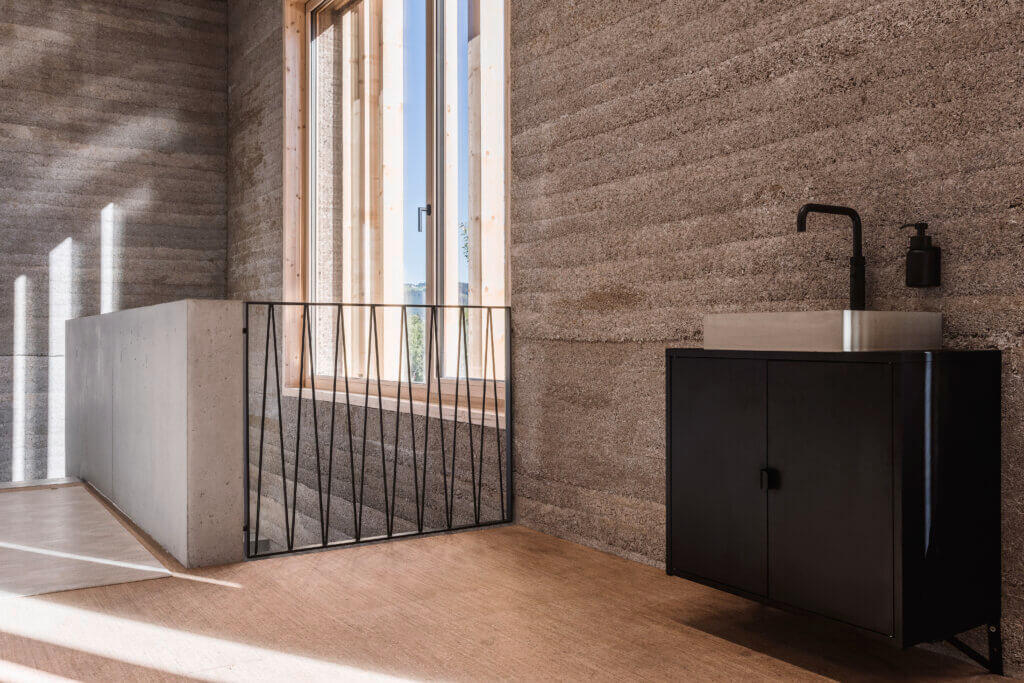
Apart from the ecological benefits, hemp scores points in other ways too: it regulates moisture and, as mentioned, temperature, is open to diffusion and, thanks to its high pH value, is resistant to rot and mold and therefore good for the indoor climate. The fact that it is sound-insulating and flame-retardant are two further plus points. Schönthaler mentions yet another: “The monolithic construction method without insulation – a hemp wall consists only of hemp, lime, minerals and sand – is not only 100 percent recyclable, but also reduces the risk of building defects.”
Good for renovations
Hemp is not only a promising sustainable building material for new buildings, but also for renovations. As hemp blocks are lighter than concrete, they are considered to have great potential for adding storeys to buildings and for loft conversions. The same also applies when it comes to the internal insulation of existing buildings. “With conventional insulation materials, you need a vapor barrier. With hemp, this is not necessary due to its capillary-active properties,” explains Schönthaler.
Does hemp also have disadvantages as a building material?
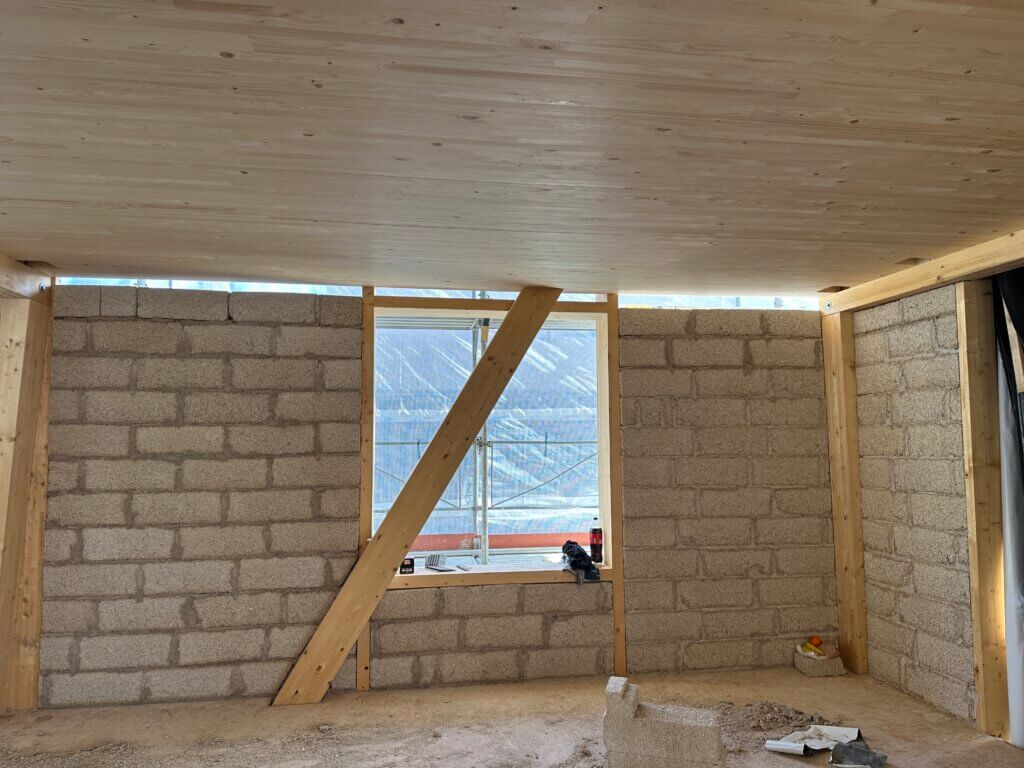
“Hemp building blocks can only bear limited loads. You can’t build load-bearing walls with them without a wooden skeleton. Caution is also required on the building site: Hemp building materials, which incidentally are approved in Austria, must be protected from water so that they do not soak in. Another disadvantage is the price, as building materials made from hemp are up to 15 percent more expensive than conventional materials, depending on their intended use. “But you shouldn’t forget one thing: Conventional insulating materials, for example, are cheaper to buy. But if you add the costs for disposal, hemp-based materials are cheaper in the end,” Schönthaler is convinced.
Hemp as a building material: Without a timber frame, it is not possible to build a load-bearing wall with hemp blocks. Photo: Hanfstein_eu
Our expert
Werner Schönthaler is the managing director of Schönthaler Bausteinwerk GmbH and Baustoffhandel GmbH in Eyrs, South Tyrol. The building biologist has been involved with ecological construction methods for many years and is considered a pioneer in the field of hemp construction.
After years of beige, greige, and subdued natural tones, it’s time to bring a little more depth back into interior design. Eggplant is one of the most exciting colors of the fall: elegant, warm, full of character—and surprisingly versatile. Interior design specialist Stefanie Winter explains how to pair aubergine effectively, where the color works particularly …
Nestled in the Styrian Alps, LUXGUT VERONICA is an extraordinary chalet for those who wish to combine seclusion, architecture, and alpine luxury in a unique way. Situated at an elevation of approximately 1,000 meters above sea level, the project combines nature, privacy, wellness, and professional hospitality into a rare residential and investment concept. VERONICA is …
Located directly on Lake Attersee, this extraordinary lakeside villa serves as an exclusive retreat in one of the most beautiful regions of the Salzkammergut. Its immediate proximity to the water, private lake access, and prime location in Unterburgau create a living experience that impressively blends architecture, nature, and privacy. Spanning approximately 378 m² of living …
SIE WOLLENNICHTSMEHR VERPASSEN?
Unser kostenloser Newsletter liefert Ihnen wöchentlich die neuesten Artikel rund ums Wohnen & Leben.
SIE WOLLENNICHTSMEHR VERPASSEN?
Unser kostenloser Newsletter liefert Ihnen wöchentlich die neuesten Artikel rund ums Wohnen & Leben.
SIE WOLLEN
NICHTS MEHR VERPASSEN?
Unser kostenloser Newsletter liefert Ihnen wöchentlich die neuesten Artikel rund ums Wohnen & Leben.