Florence is often referred to as an “open-air museum”. However, the city on the Arno, which was the capital of the newly founded Kingdom of Italy between 1865 and 1871, has much more to offer. It is not resting on its historical heritage, which attracts millions of visitors every year.
The capital of Tuscany is worth a visit for many reasons: lovers of ancient art will find just as much to their liking as contemporary art enthusiasts, fashionistas and gourmets. The fact that Florence is not a museum but a lively city is particularly attractive. As soon as you stray even just two streets from the tourist trail, you can experience Florence from its true, genuine side, watch craftsmen at work, enjoy a caffé with the locals in a small bar and breathe in the Italian way of life.
Architecture in Florence
Florence is not known as the cradle of the Renaissance for nothing and is often referred to as an “open-air museum”. After all, numerous palazzi and churches in this architectural style characterize the cityscape and attract millions of visitors every year. There are hardly any serious architectural sins to be found here, as is often the case in other cities.
The housing market
Florence, especially the old town, is not necessarily a cheap place to live. Many locals have therefore moved to the districts on the other side of the Arno or the surrounding area. According to Immobiliare.it, the average price per square meter in March was €4,734/m². Tenants had to expect to pay €20.85/m².
The 3 most famous buildings in Florence
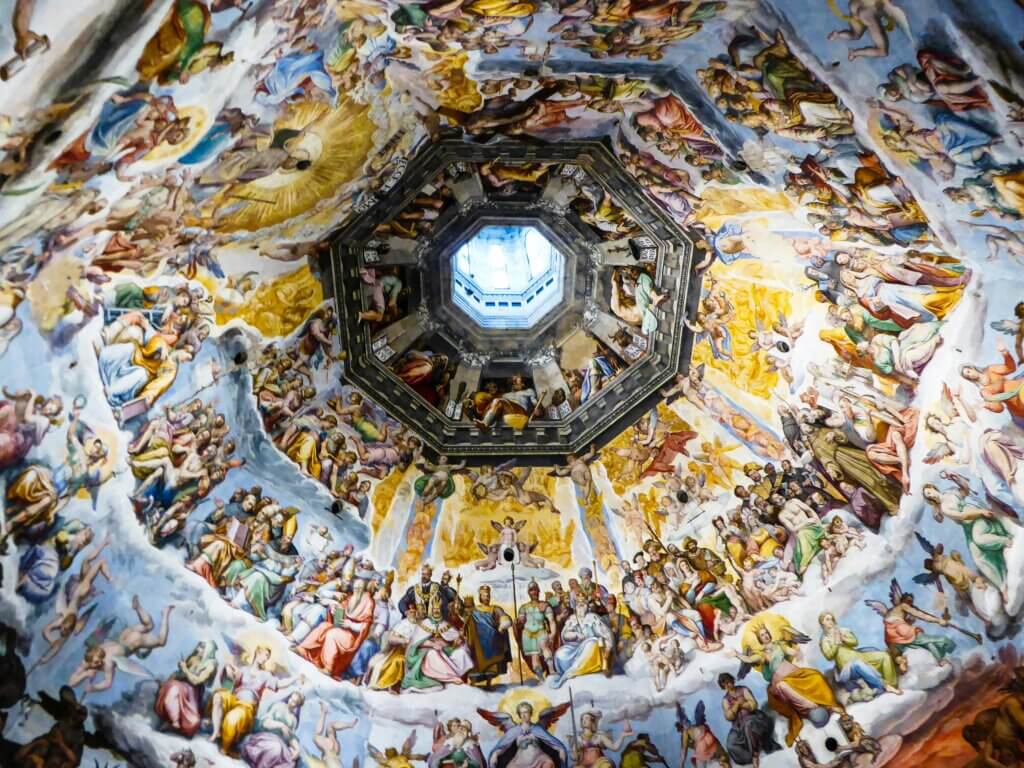
Santa Maria del Fiore
The cathedral with its huge dome is probably the city’s most famous landmark. The foundation stone was laid in 1296 and the cathedral was consecrated in 1436 – with room for 20,000 worshippers, it was the largest cathedral in the world at the time. The dome designed by Filippo Brunelleschi, a masterpiece of Renaissance architecture, deserves special attention. Also noteworthy are the campanile designed by Giotto and the Battisterio di San Giovanni. The baptistery, which was built between 1059 and 1150, is one of the oldest buildings in the city.
Palazzo Pitti
With the construction of Palazzo Pitti, the Florentine banker Luca Pitti not only wanted to create a monument to himself, but also to surpass the Medici palace, Palazzo Medici Riccardi. He therefore ordered that all the windows in Palazzo Pitti should be higher than the entrance door in the Medici palace. However, just eight years after the start of construction, in 1465, Pitti went bankrupt and construction was interrupted. Less than a century later, in 1549, the Medici family acquired the palazzo, had it extended and moved here. Today, the building, which is three times the size of the original building, houses six museums and collections.
After visiting the Palazzo Pitti, you can relax in the adjoining Boboli Gardens, one of the most beautiful Renaissance gardens.
Galleria degli Uffizi
The Uffizi Gallery is not only one of the oldest and most extensive, but also one of the most visited art collections in the world. In addition to works by German, Flemish, Dutch and French masters, the Uffizi Gallery is also home to Masterpieces of the Italian Renaissance. In addition to the “Birth of Venus” by Botticelli, these include “The Annunciation” by Leonardo da Vinci and The Madonna with the Goldfinch, one of the earliest works by the young Raphael.
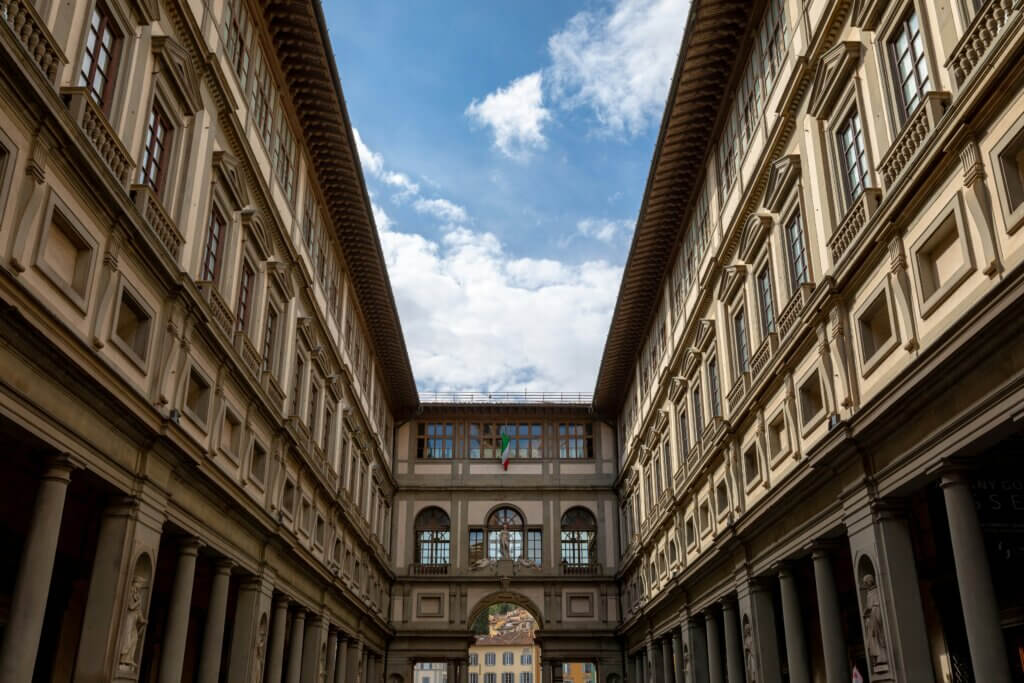
At least as impressive as the art collection, which also contains sculptures and other objects, is the U-shaped building itself. It was commissioned by Cosimo I Medici in 1560 as an office building (Uffici) for the city administration based on plans by Giorgio Vasari. An entire district of the city was demolished or integrated into the new building, such as the Romanesque church of San Piero Scheraggio and the Zecca mint. Vasari had facades erected in front of the old and new buildings to create a uniform appearance. The building was completed by Bernardo Buontalenti after Vasari’s death in 1574. It is thanks to Francesco I, Cosimo’s son, that one of the most remarkable art collections in the world is now housed here. He had exhibition rooms set up on the upper floor of the building for the princely art collection.
Shopping in Florence
Clothing, shoes, bags, but also perfume, handicrafts and antiques – Florence is ideal for shopping. Of course, in the capital of Tuscany, as in any large city, both the well-known, high-priced designer brands that have set up shop in the center, as well as some budget chains. Fortunately, there are still many small retailers offering clothing and other items outside the mainstream. A good address for original design and handicrafts is Oltrarno, the district on the other side of the Arno. If you are looking for antiques, you should also head here, specifically to Via Maggio. But there are also numerous antique stores on the other side of the Arno, in Borgo Ognissanti or Via de’ Fossi.
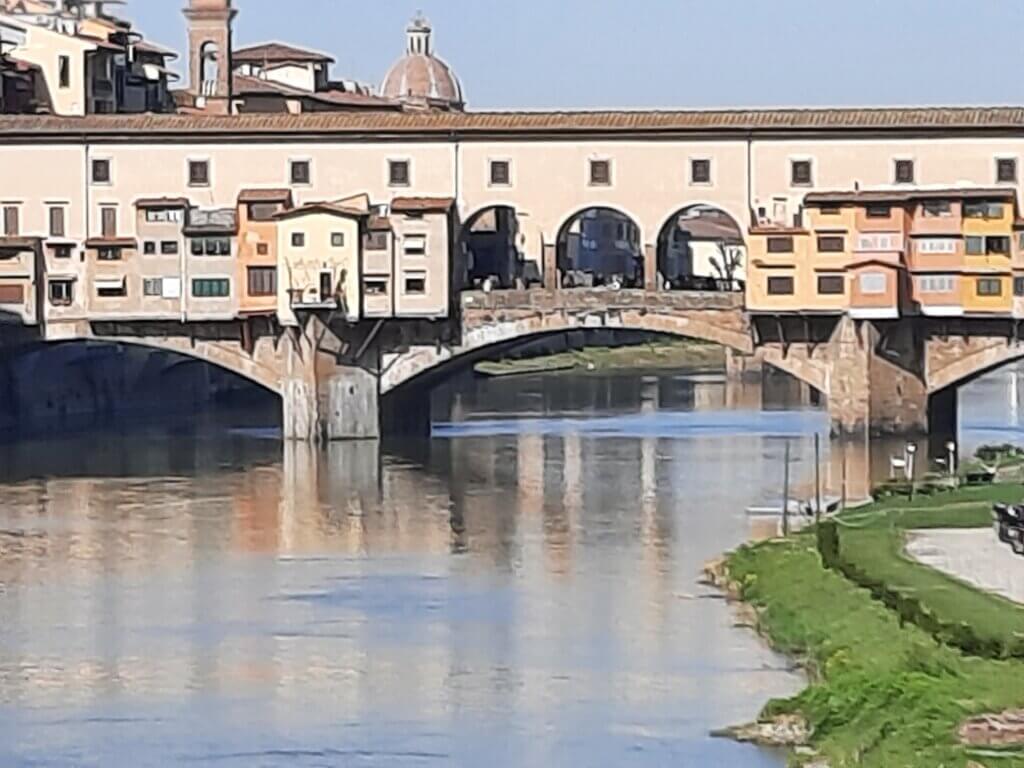
Not forgetting the jewelry: you can buy this not only on the world-famous Ponte Vecchio, but also in numerous small jewelry workshops.
The 3 most unusual stores in Florence
Antica Farmacia Santa Maria Novella
Via della Scala 16
From 1221, the monks of the nearby Dominican monastery of Santa Maria Novella processed medicinal plants from the monastery garden into essences and tinctures. Today, the pharmacy, which is considered the oldest in the world, is known for its (room) fragrances, scented candles, facial, body and hair care products. However, the pharmacy is also worth a visit for its antique furnishings, stucco and atmosphere alone.
Twisted Jazz Shop
Borgo San Frediano 21r
Jazz and blues fans will be in their element here. Rare recordings are also hidden in the shelves that reach up to the ceiling.
Mrs Macis
Borgo Pinti 38r
If you love unusual fashion, you’ve come to the right place: Carla Macis, a former designer at the Florentine fashion house Pucci, transforms fabric remnants into unusual styles.
The 3 most beautiful markets in Florence
Mercato Centrale di Firenze
Via dell’Ariento
In the market hall in the San Lorenzo district, you can not only buy fish, vegetables, fruit, meat, pasta and many other foods. Numerous stalls on the ground and upper floors also invite you to sample regional delicacies. It is no coincidence that the Mercato Centrale, built of cast iron and glass and opened in 1874, is similar to the Galleria Vittorio Emanuele II in Milan: both were designed by Italian architect Giuseppe Mengoni.
Mercato delle Cascine
Viale Lincoln
A stroll through the open-air market in the park of the same name on the banks of the Arno is definitely an experience. Every Tuesday morning, traders offer regional food, household items, clothing and much more over a distance of around two kilometers.
Mercato delle Pulci
Piazza Pietro Annigoni
Furniture, books, coins, records and much more can be found at this covered flea market – almost all year round. The flea market, which used to be located in Piazza de’ Ciompi, is only closed at Christmas and New Year.
Cuisine & indulgence
The traditional cuisine of Tuscany, and therefore also that of Florence, does not deny its rural roots. Simple ingredients such as bread, oil, pulses and seasonal vegetables are used to conjure up the most delicious dishes, many of which are vegetarian. In addition to bread and vegetable soups, the most famous dishes in the city of the Medici include stews such as ribollita and panzanella, a refreshing bread salad.
Meat lovers will not be able to get past the Bistecca alla Fiorentina. This follows strict rules: the Fiorentina must be at least four fingers thick, have the typical T-shape and be specially cut from the loin.
But don’t just try a bistecca – why not try trippa alla Fiorentina? Tripe is cut into strips and simmered for a long time with lots of roasted vegetables and tomatoes. According to some recipes, the tripe is sprinkled with plenty of Parmesan cheese before serving. We also recommend lampredotto, which the locals like to eat on the street as a snack between meals. To make it, the abomasum of a cow is minced and cooked, and either seasoned with just salt and pepper or with salsa verde or a little hot oil. The lampredotto is then stuffed into a semelle, a typical Tuscan roll. If desired, the top of the roll can be dipped into the soup in which the lampredotto is simmering – this gives the snack even more flavor.
Feasting in Florence
Cestello
Piazza di Cestello, 8
Fish and seafood are interpreted here in a modern yet timeless way. The service is unobtrusive, the atmosphere pleasant – especially on warm evenings on the terrace.
Ristorante Oliviero 1962
Via delle Terme, 51r
The menu of the restaurant, which opened in 1962 and has hosted Federico Fellini, Marcello Mastroiani and Sofia Loren, includes specialties from Tuscany as well as other Italian regions. Special highlight: pasta, bread and desserts are still homemade.
Antico Ristoro Perditempo
Borgo San Jacopo, 48r
With a view of the Arno and the Ponte Vecchio, you can also enjoy typical Tuscan dishes here – from ribollita to trippa (tripe) alla Fiorentina. Like most of the ingredients, the wine also comes from the region.
One thing is certain: Florence is definitely worth a visit. But beware: the city on the Arno can be addictive!
Related posts:
Travel series, part 6: On the road in…Strasbourg
Travel series, part 7: On the road in…Seville
Travel series, part 8: On the road in…Trieste