
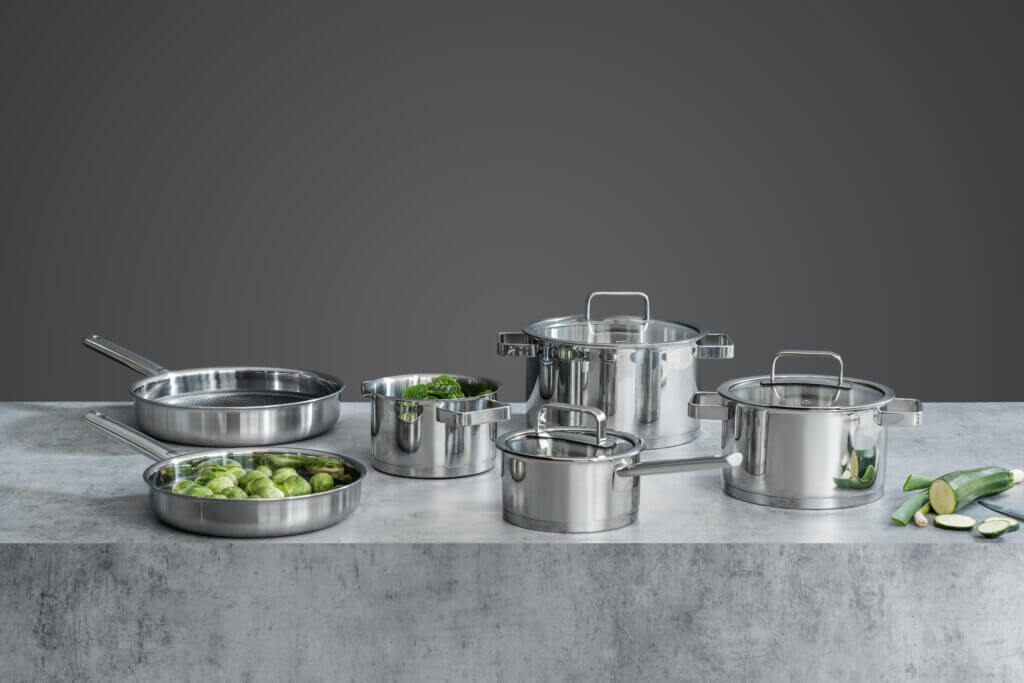
It stands for quality, functionality, durability and sustainability – accordingly, stainless steel cookware can be found not only in professional kitchens, but also in more and more households. Stainless steel also has a lot to offer visually: The reflective surface blends effortlessly into any kitchen, whether modern or classic. Stainless steel does not compete with its surroundings, but rather complements them.
What is stainless steel cookware made of?
As a rule, 18/10 stainless steel is used for cookware. According to the domestic cookware manufacturer Riess Kelomat, this is a non-magnetic, heat- and corrosion-resistant chrome-nickel steel with 18 percent chrome and 10 percent nickel. This is also known as stainless steel, often shortened to stainless steel, and inox, from the French inoxydable, i.e. rustproof.
In order to conduct the heat evenly, stainless steel pots and pans are given a special base, for example made of aluminum or copper. Most of these bases can now also be magnetized, making the cookware induction-compatible.
What are the advantages of stainless steel?
Stainless steel, especially 18/10 stainless steel, has various advantages: On the one hand, it is rustproof and robust against knocks and impacts. On the other hand, stainless steel is non-reactive, which means it is acid-resistant and does not take on any taste or smell. In addition, the material is a good heat accumulator and the aforementioned even heat distribution also ensures precise searing and controlled simmering.
Another major advantage is the durability of the material: cookware made of stainless steel can accompany the user for a lifetime. This longevity makes it a sustainable investment – not only ecologically, but also economically. Speaking of sustainability: stainless steel is recyclable.
Are there any disadvantages?
Probably the most serious disadvantage – in the truest sense of the word – is the weight of the material: compared to other materials, stainless steel, and therefore the cookware made from it, is relatively heavy. As its non-stick properties are poor, fat must always be used when frying.
How do you clean stainless steel cookware?
Stainless steel cookware is generally suitable for the dishwasher. However, according to Riess Kelomat, the shiny surface remains beautiful for longer if it is cleaned manually with a sponge and mild detergent. Stainless steel should never come into contact with scouring agents or steel wool. If stains prove to be stubborn, the manufacturer advises using a special stainless steel cleaner.
To avoid water marks, the dishes should be dried thoroughly after washing.
If water marks do appear or the stainless steel cookware becomes discolored after a while, it can be cleaned with lemon or vinegar and a soft cloth or sponge.
Further tips:
#1 Only add salt to the cooking water after the water has boiled – this will prevent corrosion marks on the base of the pan
#2 Before adding oil or fat to your stainless steel pan, heat it briefly – this prevents the food from sticking
Photos: © Riess Kelomat
Related posts:
How to make your copper tableware shine again