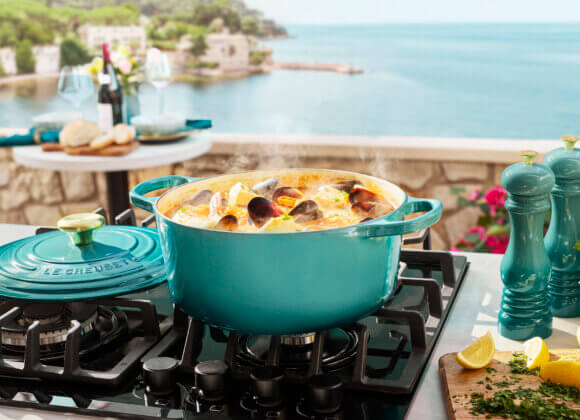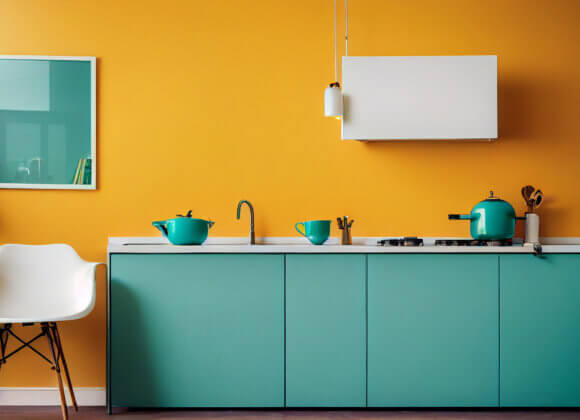

Ceramic cookware is becoming increasingly common in home kitchens. However, it’s important to distinguish between two types: There is cookware made entirely of ceramic, as well as pots and pans where only the interior is coated with ceramic. The exterior and core, on the other hand, are usually made of a sturdy metal core. The advantage of this type is obvious: it is considerably lighter than cookware made entirely of ceramic.
What is ceramics?
Ceramics are essentially made of inorganic materials such as clay, minerals like feldspar and/or quartz, and water. These are mixed, shaped, dried, and fired. However, not all ceramics are the same: the term actually encompasses porcelain as well as earthenware and stoneware. The latter is also the material used to make cookware.
The difference lies in their different compositions and the corresponding firing temperatures. Porcelain is made from a special type of porcelain clay (kaolin), and it is fired at a temperature of about 1,450 degrees Celsius. Stoneware is made from clay with a high content of aluminum and iron oxide and is fired at 1,100 to 1,300 degrees. Both porcelain and stoneware are impervious to water. To produce earthenware, which is fired at 970 to 1,300 degrees, clay, quartz, feldspar, and, for example, calcite are used. Earthenware is not naturally impermeable to water. To make it so, earthenware tableware must be glazed and fired a second time.
What are the advantages of ceramic cookware?
Ceramic has several properties that are definitely advantageous when cooking: For one thing, it stands out for its hardness and scratch resistance. Second, depending on its quality and design, ceramic-coated cookware is suitable for high temperatures of up to 400 degrees. Pure ceramic cookware, on the other hand, doesn’t handle heat quite as well: it should not be exposed to temperatures higher than 260 degrees.
In addition, the material is hard, scratch-resistant, and tasteless. Another advantage is that ceramic cookware retains heat particularly well—this facilitates even cooking and also helps save energy. Thanks to the material’s natural nonstick properties, very little fat is needed for cooking and frying. At the same time, ceramic pans, baking dishes, and pots—or those with a ceramic coating—are considered a good alternative to nonstick pans with a PTFE (Teflon™) coating, according to the German Consumer Center.

Are there any disadvantages?
Yes. The saying “Every advantage has its disadvantage” also applies to ceramic cookware. Glazes and paints applied to ceramic items may contain heavy metals such as lead, cadmium, or cobalt, which can leach into food, warns the German Consumer Center. Therefore, when making a purchase, look for relevant information; if in doubt, opt for a white or unglazed product. Furthermore, a ceramic nonstick coating can lose its effectiveness over the years—so be sure to prioritize quality.
Is ceramic cookware easy to clean?
Ceramic pots and pans are easy to clean. In most cases, it’s enough to wash them by hand with water and a little dish soap. If there are any stubborn residues, they should never be removed with abrasive cleaners or steel wool. Instead, fill the pot or pan with lukewarm water and plenty of dish soap, and let it soak for a while. Then clean the ceramic cookware as usual with a nylon brush or a sponge.
Good to know:
- Avoid temperature shocks. Therefore, let the ceramic cookware cool down before cleaning it.
- Ceramic or stoneware cookware should be completely dry before being put back in the cabinet
- Do not use cold-pressed olive oil when cooking with ceramic cookware. At high temperatures, it can cause the surface to stick, which compromises the nonstick properties. It is better to use oils that can withstand high heat.
Related posts:
Cookware series, part 1: Stainless steel
How to make your copper tableware shine again
Beast Blender: Why Personal Blenders Are Replacing Stand Mixers