
A new house that wasn’t meant to look new. An open, square courtyard built with materials that are allowed to age. And a real estate professional who’s in the barn at the crack of dawn today before heading to his office in Vienna: How Stephan Altenburg and his family have created a new way of life in the Vienna Woods.
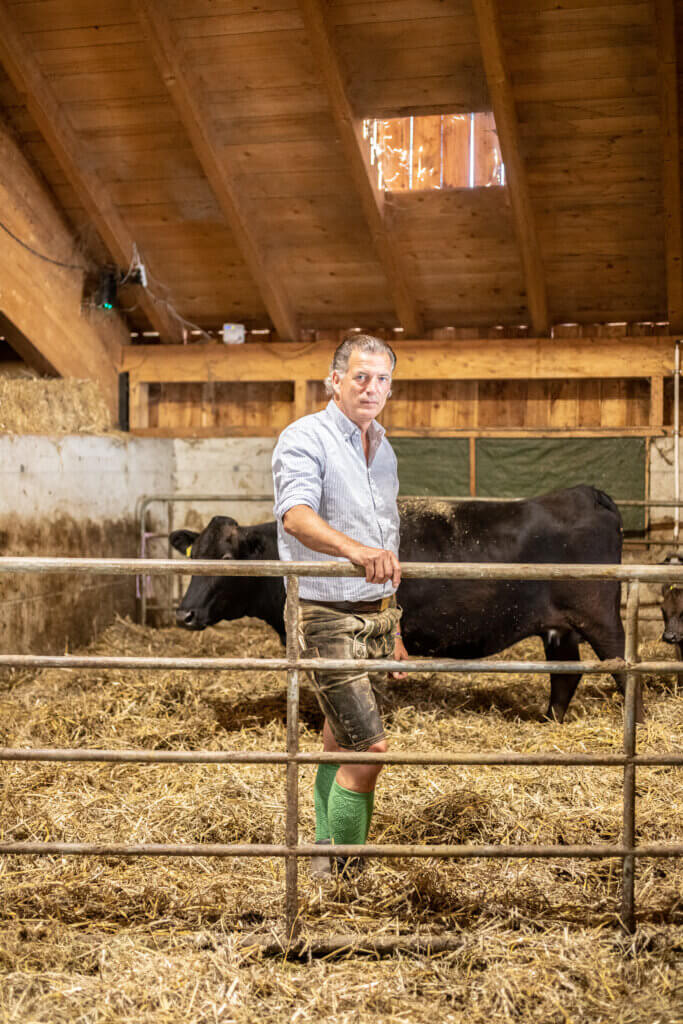
By 5:45 a.m. today, Stephan Altenburg had already taken care of things that his former self probably wouldn’t even have begun to think about. He goes to the barn, checks on the animals, feeds them, and makes sure everything is in order. “I’ve struggled my whole life to get up in the morning,” says the founder and owner of “Altenburg Realitäten,” a renowned real estate company in Vienna, where he also lived until six years ago. And he’s adopted a different rhythm, because country life has turned the former morning grouch into an early riser. Today, he considers those first hour and a half to be a real bonus: the peace and quiet, the fresh air, and the connection with the animals. A day that begins before the first espresso is even ordered elsewhere.
Out of the city, back to the countryside
At first, this change wasn’t intended to be quite as radical as it sounds today. Altenburg, the great-great-grandson of Emperor Franz Joseph, grew up in the countryside in Upper Austria, came to Vienna to study, built his real estate business here, and stayed. For about 25 years, the federal capital was the center of his life.
However, with a new phase in life and the desire for family life outside Vienna, the longing for the countryside returned. “My wife Sintija and I have always said that our children shouldn’t grow up in the big city,” says Altenburg. They were never looking for a typical single-family home, but rather something with history: perhaps an old farmhouse, a small castle, or a historic estate with a few hectares of land—and all of it within a distance of about 30 to a maximum of 60 minutes from Vienna.
Eventually, a location was found in Brand Laaben in the Vienna Woods that only partially met their expectations. The location was right, and so was the lot. However, the existing farmhouse was in such a state of disrepair that a practical renovation seemed virtually impossible. So another idea took shape: “We’ll build something new where you don’t even notice that it’s new,” said Altenburg.
Four years passed between finding the lot and moving in. The paperwork and appeals alone took two and a half of those years. Once construction could finally begin, things moved quickly: About a year later, the family was able to move in.
A New Farmstead Built According to Old Rules
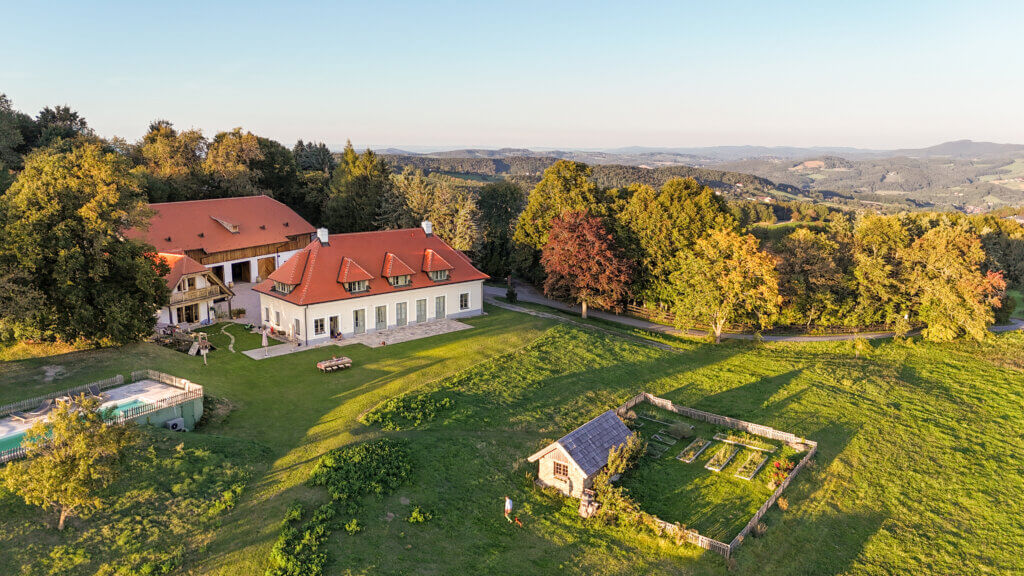
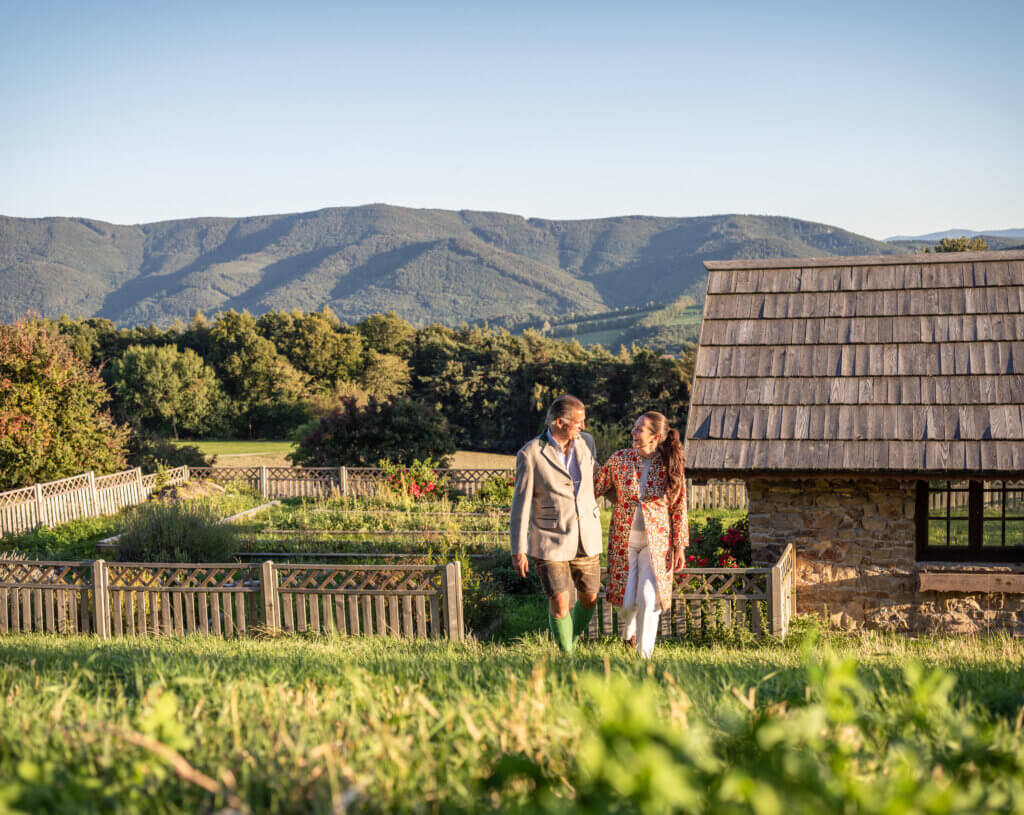
It is precisely this contradiction that makes the Altenburg estate so charming today: it is new, yet it is not meant to look new. In collaboration with the architect, a contemporary interpretation of the historic square farmstead was created—an “open square farmstead.” The residence, a farm building with a stable, another structure, and a covered garage form an ensemble that appears to have evolved organically rather than been planned.
For Stephan Altenburg, who has been working in real estate for decades, much of this was clear from the start. The goal was not to build something as spectacular as possible, but rather as natural as possible. Bricks instead of experimental building materials, classic stucco, a traditional tile roof. Much of it was deliberately designed the way it could have been built generations ago.
It’s part of the house’s history that Stephan Altenburg wasn’t the only one with specific ideas about the project. And his wife, Sintija, has experience renovating and preserving old houses: In Latvia, she has brought several severely dilapidated buildings back to life and turned them into unique accommodations for short-term rentals.
A House That Blends Into the Landscape
Just as important as the building itself was its location on the property, which sits at an elevation of about 600 meters above sea level. Like many traditional farmsteads, the old farm was arranged in a way that seems almost “backward” from today’s residential perspective: The animals were kept where the sun and the view were best, while the farmhouse was situated more sheltered behind them.
In the new construction, this principle was reversed. The house was moved to where the landscape opens up. Light and views became essential elements of the design. Here, architecture does not mean placing a building in the landscape as effectively as possible. Rather, it should be subordinate to the landscape.
A Country House Without the Country House Cliché
Anyone who, upon seeing a country estate, stables, and the Vienna Woods, automatically thinks of farmhouse-style cabinets, checkered curtains, and rustic decor is way off the mark.
For while the estate may, of course, fit right into country life on the outside, much of the interior decor that had surrounded the family in Vienna has been preserved. Furniture, paintings, and items steeped in family history simply came along with them.
“Judging by the decor, it could just as easily be a city apartment,” says Altenburg. The artificial image of a rustic country house was never the goal. He suggests that farmhouse-style cabinets and checkered patterns might be desirable in a hunting lodge or weekend home. “But that doesn’t fit with our everyday life.”
At around 360 square meters, the house has a spacious layout without veering into the monumental. There was also a rather pragmatic reasoning behind this: “Children grow up and eventually move out,” says Altenburg. So why create a home that will later consist mainly of unused rooms? And as in many large homes, family life doesn’t actually take place where the floor plan would originally suggest it would.
In the end, everyone ends up in the kitchen
There’s a living room, a lounge area, and a separate dining room—and yet Altenburg’s favorite spot is the room where, apparently, everything happens anyway: the kitchen.
With a breakfast nook and a kitchen island, it’s the heart of daily life. This is where the family gathers; this is where they cook, chat, and get organized. The actual dining room? “It’s used three times a year for family gatherings,” Altenburg says dryly.
That said, guests are always welcome—and there are plenty of them. After all, a house in the country with plenty of space, animals, and a view tends to have a certain magnetic appeal for friends and family. In short: The supposedly quiet country life is by no means always quiet. Visitors come and go, neighbors drop by, someone brings something, someone needs something—a lot of things happen more spontaneously than in the city.
From Real Estate to Farming
Along with the house, the Altenburgs also acquired land—quite a lot of it. And with about 22 hectares, the question soon arose: What do you actually do with it?
“At first, we hadn’t planned in detail that this would turn into a farming operation,” says Altenburg. However, animals were part of the vision for their new life from the very beginning. This was also because they wanted their four children—now 25, 23, 7, and 5 years old—to develop a direct connection to farming: to animals, to responsibility, and ultimately to the food cycle. “Although the two older ones don’t live with us on the farm, they love coming to visit and do so often.”
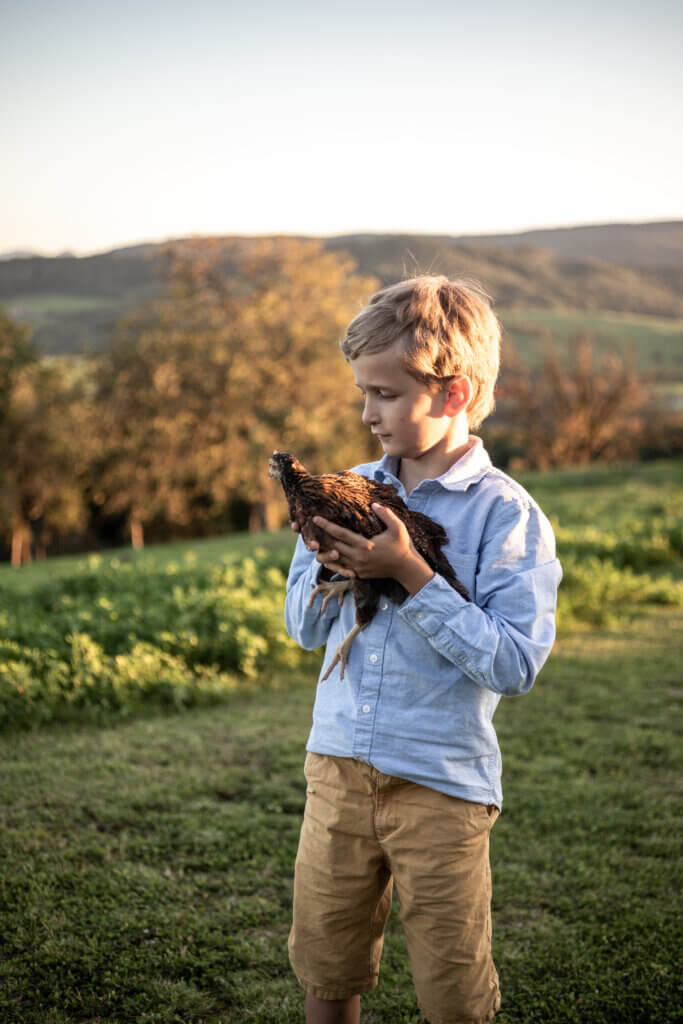
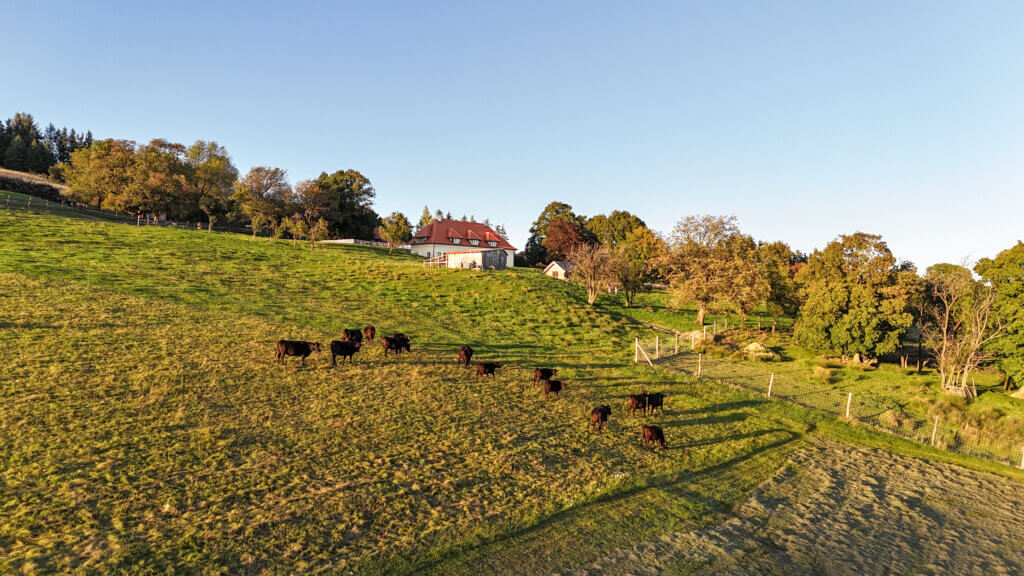
Wagyu cattle, fallow deer, and chickens have been part of the farm almost from the very beginning. The decision to raise Wagyu—there are currently 25 on the farm—was not merely romantic but also a thoroughly business-minded one: He is convinced that anyone running a small farm in relative proximity to Vienna must prioritize quality. Volume was never the goal.
And when you suddenly experience food right where it’s actually produced, you inevitably develop a different perspective on enjoyment. Vegetables come from your own garden, eggs from your own chickens, and meat from your own livestock or from the region. “You just notice the difference,” says Altenburg. Regionality and seasonality thus become less of a lifestyle concept and more a part of everyday life.
Just how romantic is country life, really?
Of course, a lot of it looks incredibly idyllic: looking out over the meadows in the morning, feeding the animals, picking vegetables from your own garden. But a farm also comes with responsibilities.
Want to take a spontaneous trip for an extended period? That’s difficult. Two days work out fine, but after that, you have to figure out who will take care of the animals. Vacations require planning. And your daily routine isn’t dictated solely by your own schedule either.
Social life is changing, too. “In the city,” says Altenburg, “you sit down in a coffeehouse and run into someone by chance, go out on a whim, or accept an invitation. In the countryside, you have to nurture relationships more consciously.” But this family man and avid hunter definitely sees that as an advantage. You choose more carefully who you spend time with, plan cultural activities more thoughtfully, and invite friends over with intention. In other words: “Your social circle becomes smaller, but more meaningful!” Perhaps that’s also a rather contemporary definition of luxury.
Experience the Farm Firsthand
If you’d like to see the Altenburg Farm for yourself, stop by the farm’s own store and discover products sourced directly from the farm. In addition, events are held regularly at the farm. A special highlight is still to come this year: From December 11 through 13, the farm is hosting its Advent market. For current dates and further information, visit www.gutshof-altenburg.at
All photos: Schlossseiten.at