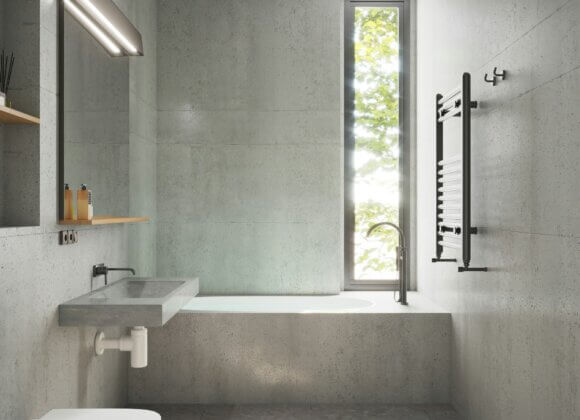

Seamless, minimalist, and surprisingly versatile: microcement has evolved from a minimalist architectural material into a popular alternative to traditional tiles. Interior designer Stefanie Winter explains where microcement can be used in the bathroom, what’s important when it comes to installation and waterproofing—and why the seemingly uncomplicated surface is best left to the professionals.
Microcement is one of those materials that can transform a space without drawing too much attention to itself. No joints, barely visible transitions, a mineral-based surface, and an appearance that can range from very subdued to deliberately vibrant, depending on how it’s applied. This look is particularly in demand in bathrooms. But as minimalist as the finished surface may appear, its application can be quite complex.
What is microcement, and how is it applied?
Microcement is a very thin, cement-based coating that can be applied to a variety of substrates. Depending on the condition of the surface and the system used, it is even possible to refinish existing tiles with it. This makes the material particularly appealing for renovation projects.
Contrary to what the name might suggest, this process does not involve applying a solid layer of concrete. Microcement is applied in several thin layers. The surface is sanded between each layer, and a sealant is applied afterward.
It is precisely this artisanal craftsmanship that ensures no two surfaces look exactly alike. “That’s also what I like about it,” says Winter. “It’s not completely perfect and uniform; instead, it has texture and feels alive.”
The characteristic cloud-like patterns, fine trowel marks, and varying shades are therefore not flaws, but part of the desired look.
Where can microcement be used in the bathroom?
In general, microcement can be used in a wide variety of ways in the bathroom: on walls and floors, around the sink, and—with the proper installation—even inside the shower.
According to Winter, the material really shines on larger surfaces. “I really like microcement on larger surfaces because that’s where its calm, seamless look really comes into its own.”
This is especially beneficial for smaller bathrooms. While tiles create a visible grid due to their grout lines, a seamless microcement surface can make the room appear more visually calm and, as a result, more spacious.
That doesn’t mean, however, that the entire bathroom has to be finished in microcement. On the contrary: Winter likes to combine the material with wood, natural stone, or select tiles. This keeps the space interesting and adds depth. Winter: “For me, the entire bathroom doesn’t always have to be made of a single material.”
Is microcement more expensive than tile?
There’s no one-size-fits-all answer to that. Compared to an inexpensive standard tile, microcement is generally more expensive. That’s because a lot of work goes into that seemingly simple surface: the substrate must be prepared, then several layers are applied, sanded, and finally sealed.
If, on the other hand, you compare microcement to high-quality tiles installed by a professional, the cost can be quite different.
The material can be particularly appealing for renovations. If the subfloor and existing tile covering are suitable, microcement can be applied directly over them under certain conditions. This can eliminate the need for some time-consuming demolition work.
Winter therefore recommends not focusing solely on prices per square meter: “I would never just compare the price per square meter; instead, I would always ask: ‘What will the finished surface cost me?’”
What are the pros and cons of microcement?
The most obvious advantage is the seamless look. Large surfaces appear calm and uniform, which can make small bathrooms appear more spacious. The absence of numerous grout lines also makes cleaning easier.
Added to this is the creative freedom. The color, texture, and application method can all be varied. This results in a surface with a unique character, rather than the perfectly uniform appearance of an industrially manufactured material.
However, that is precisely where a potential challenge lies. Anyone expecting a 100 percent uniform surface might be less than satisfied with microcement. “Every surface is a little different,” explains Winter. “But at the same time, that’s something you have to appreciate.”
Another crucial factor is the application process. Microcement is only somewhat forgiving of flaws in the substrate or in the layer structure. If the preparation or application is substandard, cracks or other damage may occur later on. Professional application is therefore essential.
Is microcement 100% waterproof?
There’s an important misconception here: microcement itself isn’t automatically waterproof.
In the bathroom, it really comes down to the entire system—and, especially in wet areas, to proper waterproofing beneath the visible surface. In addition, the microcement must be properly sealed.
“In the bathroom in particular, the entire substructure and proper sealing are crucial,” Winter emphasizes. For this reason, especially in the shower, only systems that are specifically designed to withstand constant exposure to water should be used.
The interior designer would not cut corners or improvise here. If moisture were to seep into the subfloor due to faulty construction, the renovation could end up being considerably more costly.
How do you properly maintain and clean microcement?
In everyday use, a microcement surface that has been properly installed is relatively easy to maintain. One advantage in the bathroom: There are no traditional tile grout lines where dirt or deposits can accumulate over time.
For routine cleaning, water and a mild cleaner are usually sufficient. However, you should avoid using harsh cleaning agents, abrasive cleaners, and stiff brushes, as they can damage the protective sealant over time.
Depending on the level of wear and tear, it may be advisable or necessary to refresh this sealant after a few years. This restores the surface’s protection without having to replace the entire flooring.
Can you apply microcement yourself, or do you need a professional?
Microcement is now also available for DIYers. Technically speaking, it’s certainly possible to apply the material yourself. In the bathroom, however, Winter would advise caution—especially on floors and anywhere else where the surface is regularly exposed to water.
After all, it’s not just a matter of whether the visible finish turns out beautifully. The substrate must be stable and properly prepared; in wet areas, the waterproofing must be effective; and mistakes can also occur during sanding and the final sealing process.
Experienced DIYers can certainly give it a try on a smaller wall surface outside the immediate wet area. When it comes to the shower, however, the expert’s recommendation is clear: “Please have a professional do it.”
That’s because a mistake that might not even be visible at first can lead to moisture damage later on—and thus end up being significantly more expensive than having the work done professionally from the start.
How durable is microcement compared to tile or concrete?
When installed properly and maintained appropriately, a microcement surface can remain beautiful for many years. However, in terms of durability, it can only compete with high-quality tile to a limited extent.
A tile is generally very durable and hardy. Microcement, on the other hand, is a coated surface whose sealant can wear away over time, depending on usage and wear and tear. The advantage: it can be renewed.
For Winter, the decision is ultimately a matter of priorities. “Do I want a surface that’s as durable and low-maintenance as possible? If so, tile is still a great solution. But if I want that calm, seamless, and slightly more personalized look, then microcement is simply beautiful.”
What colors and finishes are available?
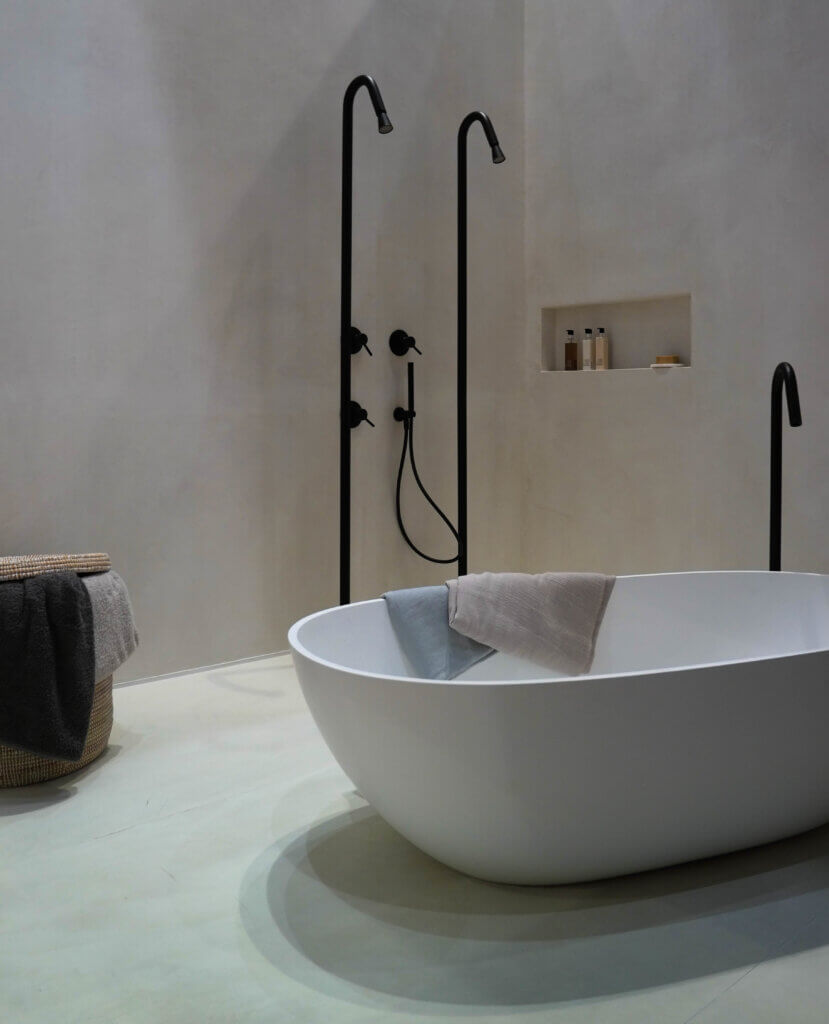
Anyone who automatically thinks of cool concrete gray when they hear “microcement” is underestimating its design possibilities. The material is now available in a wide range of colors—from white and sand to beige and greige, all the way to gray, brown, or anthracite.
Winter tends to prefer warmer color schemes for living spaces and bathrooms. “A beautiful khaki, greige, sand, or warm beige pairs wonderfully with wood and natural materials, and to me, it often feels cozier than the classic cool concrete gray.”
However, the application technique is at least as important as the color itself. Depending on how the material is troweled and sanded, the same color can look completely different.
Her tip, therefore: “Don’t make your decision based on a small color swatch; instead, look at the largest possible sample.” Only then can you see how the color, texture, and trowel finish actually interact.
What is the difference between microcement and polished concrete?
At first glance, microcement and polished concrete can appear very similar: Both feature a minimalist, mineral-like appearance with few interruptions. From a construction standpoint, however, they are two completely different solutions.
Polished concrete is, in fact, made of concrete and forms a correspondingly solid floor structure. Microcement, on the other hand, is applied only as a very thin coating over an existing, suitable substrate.
This is a significant advantage, especially for renovations. It allows you to create a concrete-like, mineral finish without having to pour a new, solid concrete floor.
Stefanie Winter sums up the difference in a simple way: “With polished concrete, the concrete is the floor. With microcement, the microcement is the surface.”
This makes microcement one thing above all else: not a substitute material that attempts to imitate concrete or tile, but a unique option for interior design—especially for those who appreciate seamless surfaces, warm mineral tones, and a deliberately non-uniform finish in their bathrooms.
Our Expert

Stefanie Winter is the owner of S.TEFANIE. interior.studio. For this Graz native, home design is the visible expression of our personality. She creates spaces that bring clarity, tell stories, and help people feel truly at home. With a keen sense of color, materials, and atmosphere, she transforms houses and apartments into favorite places full of character.
Website: http://www.stefanie.studio/
Related posts:
Bathroom Makeover: Ideas for a Fresh Look in Your Bathroom
Preventing Legionella: Causes, Risks, and Protection
Laundry Baskets & More: How to Organize Your Laundry Perfectly