
In many Austrian families, All Saints’ Day is just as unimaginable without a Striezel as Christmas is without a tree. But that’s not just because this yeast pastry tastes so good—it’s also a cherished tradition that has been upheld for centuries.
How long has the All Saints’ Day Striezel been around?
For breakfast, as a snack after a visit to the cemetery, or as a gift when visiting relatives—the Allerheiligenstriezel, which is typically braided from three, four, or six strands of dough, is a must-have in many households on November 1. Originally, this sweet yeast pastry was placed on the graves of the deceased so that they would have food on All Souls’ Day. Later, All Saints’ Day braids—known as “Allerheiligenzöpfe” in western Austria—were distributed to the poor on November 1 on behalf of the deceased. In return, those who received them were expected to pray for the deceased.
Starting in the 18th century, Striezel—which, incidentally, are often made from brioche dough—were also given as gifts to family members or by godparents to their godchildren—a custom that continues to this day in some regions of Austria. On the one hand, the Striezel is meant to bring good luck to the godchild; on the other, it is meant to strengthen the bond between the giver and the recipient. By the way: The earliest known reference to the Striezel comes from the “Nachrichtenbuech” (1699) from Saxen, Upper Austria, in which the pastry is referred to as “Heiligenstriezel.”
What is the significance of the shape of the Allerheiligenstriezel?
As far back as ancient Egypt, women and girls would cut off their long hair—which had been braided into a plait—as a sign of mourning when there was a death in the family. Often, this plait was then placed in the grave with the deceased. Over time, people began offering pastries shaped like braids instead of hair. The Greeks, Romans, Germanic peoples, and Celts, on the other hand, believed that braided objects—and thus braids as well—were meant to bring good luck, blessings, fertility, and strength.
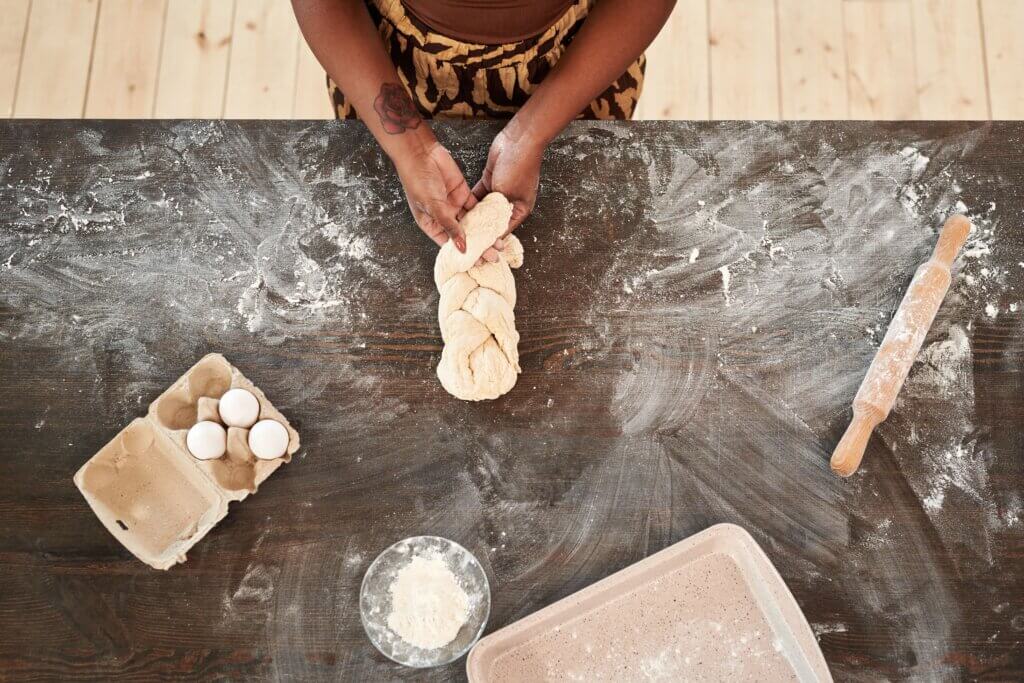
All Saints’ Day Striezel Recipes
All Saints’ Day Striezel Made with Brioche Dough (Grandma Susi’s Recipe)
Ingredients for one Striezel:
190 g lukewarm milk
90 g butter
500 g all-purpose flour
7 g salt
75 g fine granulated sugar
10 g rum
2 egg yolks
1 cube of yeast
1 egg for brushing, coarse sugar for sprinkling
Preparation:
Gently warm the milk and butter, then mix in the remaining ingredients—crumbling the yeast as you go. Knead until the dough is smooth and pulls away from the sides of the bowl. Cover the dough with a cloth and let it rise for about 20 minutes. Then divide the dough into three equal parts, shape them into three strands, and braid them into a Striezel. Cover the Striezel and let it rise again for about 20 minutes. Preheat the oven to 170 degrees Celsius on the convection setting. Brush the Striezel with the beaten egg and sprinkle with coarse sugar. Then bake the Striezel on the middle rack for about 40 to 45 minutes.
All Saints’ Day Striezel with Raisins (Source: Finis Feinstes)
Ingredients for 2 small Striezel
200 ml lukewarm milk
½ teaspoon salt
50 g fine granulated sugar
1 packet vanilla sugar
grated zest of ½ organic lemon
2 egg yolks
1 cube of yeast
500 g Finis Finest Flour, sifted
100 g soft butter
40 g raisins (optionally soaked in rum beforehand)
1 egg for brushing
Preparation:
Warm the milk. Mix about half of the warmed milk thoroughly with salt, granulated sugar, vanilla sugar, lemon zest, and egg yolks. Crumble the yeast and dissolve it in the remaining milk while stirring. Sift the flour and beat it with the two milk mixtures using a dough hook until a smooth dough forms. Add the butter and raisins and knead them into the dough. The dough is ready when it pulls away easily from the sides of the bowl as you knead.
Next, cover the dough with a cloth and let it rise at room temperature for about 1 hour, until it has roughly doubled in volume. Knead the dough again, divide it into six equal pieces, and shape them into strands. Braid three strands together to form a plait. Tuck the ends of the dough under the base of the braid and press them down lightly.
Place the braids on a baking sheet lined with parchment paper, cover with a cloth, and let them rise again for about 30 minutes. Brush them with the beaten egg and bake in a preheated oven on the middle rack at 170 °C for about 30 minutes, until golden brown. If desired, sprinkle with powdered sugar before serving.
What other traditions are there for All Saints’ Day?
In addition to baking, eating, and giving away the All Saints’ Day braid, include decorating graves, grave blessings, lighting candles, visiting cemeteries, and laying wreaths at war memorials. In some towns, such as Vösendorf, an All Saints’ Day procession is also part of the program.
What exactly is All Saints’ Day?
The holiday was established to commemorate the saints and martyrs of the Christian Church. In the 4th century A.D., they were commemorated each year on the respective dates of their deaths; later, instead of many separate days, there was just one day of remembrance—All Saints’ Day. Beginning in the year 609, this day was celebrated on the first Friday after Easter, but since the ninth century, the feast has been observed on November 1.
In the late 10th century, Abbot Odilo of Cluny established November 2 as a day of remembrance for all the faithful who had died. Over the years, the two holidays have merged—possibly because All Saints’ Day became a public holiday. This makes it easier to plan cemetery visits and similar activities on that day than on All Souls’ Day, which is a regular workday.
Similar articles:
Cottage Cheese: The Underrated Kitchen Star—Plus 3 Recipes