Whether crisp and fresh, honey-sweet, or deep dark and aromatic: Grapes are among the most versatile fruits of late summer and fall. But how long have people actually been eating grapes? Why are some seedless? And just how healthy are these sweet berries really? A brief guide to grapes—and four grape recipes that show these fruits are capable of much more than just fruit salad.
Pluck a few grapes from the stem, pop them in your mouth—done. Hardly any other fruit makes it this easy for us. Yet behind this little berry lies a surprisingly rich history. Grapes have been part of human life for millennia; they’re eaten fresh, dried, turned into juice, and, of course, made into wine—and in the process have developed such a wide variety of cultivars that the fruit section at the supermarket seems downright modest by comparison.
Grapes are often underestimated in the kitchen. After all, their sweetness isn’t just great for breakfast or dessert. They pair wonderfully with strong cheeses, nuts, rosemary, onions, rice, and even savory sauces. So it’s high time to take a closer look at the grape.
The History of the Grape
The relationship between humans and grapevines dates back a very long time. Archaeological and genetic studies trace the early centers of viticulture to Western Asia and the region south of the Caucasus, respectively. As early as several thousand years ago, wild grapevines were being used there and eventually cultivated intentionally. Evidence of winemaking in the Caucasus region dates back some 8,000 years. From there, viticulture spread via trade routes and migration patterns to the Mediterranean region and later throughout Europe.
But grapes were by no means of interest solely for wine production. They could be eaten fresh, dried, and preserved relatively well. In addition, the grapevine had a decisive advantage: particularly desirable plants could be propagated using cuttings. This made it possible to preserve desired characteristics across generations.
Over thousands of years, the originally rather small wild grape evolved into an enormous variety of different grape varieties. People selected larger berries, higher sugar content, different colors and aromas—and, depending on the intended use, ultimately very different characteristics as well.
Today, therefore, a rough distinction is made between table grapes, which are intended for direct consumption; wine grapes, used for wine production; and varieties that are particularly well-suited for drying. Incidentally, what we commonly refer to as a “grape” in everyday life is, botanically speaking, usually a fruit of the species Vitis vinifera.
How many different types of grapes are there?
Green, red, or blue—if you go by what’s available at the supermarket, you might think the world of grapes is simple to explain. In fact, the opposite is true.
The International Organization of Vine and Wine (OIV) estimates that there are more than 10,000 grape varieties worldwide. These include both wine grapes and table grapes, as well as varieties used for raisins or other purposes.
And the differences are by no means limited to color. Grapes can be almost black, deep purple, red, pink, yellowish, light green, or nearly transparent. Some are round, others oblong; some have a very thin skin, while others have a much firmer one. The flavor spectrum also ranges from crisp and fresh to tart, all the way to distinctly sweet, floral, or nutmeg-like.
In recent decades, seedless varieties have become particularly popular among table grapes. Well-known examples include the light-green Thompson Seedless—also known as Sultanina—the red Flame Seedless and Crimson Seedless, as well as dark varieties such as Autumn Royal.
Still, it’s hard to say which grape is the best. For pure enjoyment, many people prefer particularly crisp, seedless varieties. When cooking, however, aromatic grapes with slightly thicker skins can be quite exciting.
Why do some grapes have seeds and others don’t?
Seeds are actually a natural part of the grape: They form after pollination and fertilization and, under natural conditions, would ensure the next generation.
In many seedless table grapes, this process works differently. The most common mechanism is called stenospermocarpy. In this process, fertilization occurs first, but seed development stops very early on. In the finished grape, at most small, soft remnants of seeds remain, which are usually not even noticeable when eaten. Less commonly, grapes undergo a process called parthenocarpy, in which the fruit develops without prior fertilization.
Strictly speaking, “seedless” does not mean that every variety is completely devoid of seeds inside. Small, soft vestigial seeds are certainly possible. It is no coincidence that seedless grapes now make up a large portion of the market. Seedlessness is a highly sought-after trait in table grapes and has therefore long been a specific focus in breeding programs.
Are grapes healthy?
Yes—even though their pronounced sweetness can sometimes cause confusion. Grapes are largely made up of water and provide, among other things, vitamin C, vitamin K, potassium, and various phytochemicals. In addition, whole grapes contain dietary fiber, primarily in their skins.
Their polyphenols are particularly interesting. These include various plant compounds with antioxidant properties. Red and dark grapes tend to contain more of these than light-colored varieties. Resveratrol, which has been the subject of much discussion, is also found in red and purple grapes, among other sources. However, one shouldn’t assume it has miraculous effects: Individual plant compounds are not a cure, and—especially in the case of resveratrol—many of the bold health claims made about it lack sufficient scientific evidence.
Grapes also contain natural fruit sugar. That doesn’t make them unhealthy, but it explains why you can eat surprisingly large quantities of these small berries very quickly. As part of a varied diet, they’re still a good choice—and as a whole fruit, they’re nutritionally more beneficial than, say, grape juice, which lacks a significant portion of the dietary fiber.
And then there’s another very practical health benefit: grapes are a fruit that don’t need to be peeled or cut. What’s within easy reach on the table is usually what gets eaten.
Grape Recipes to Try at Home
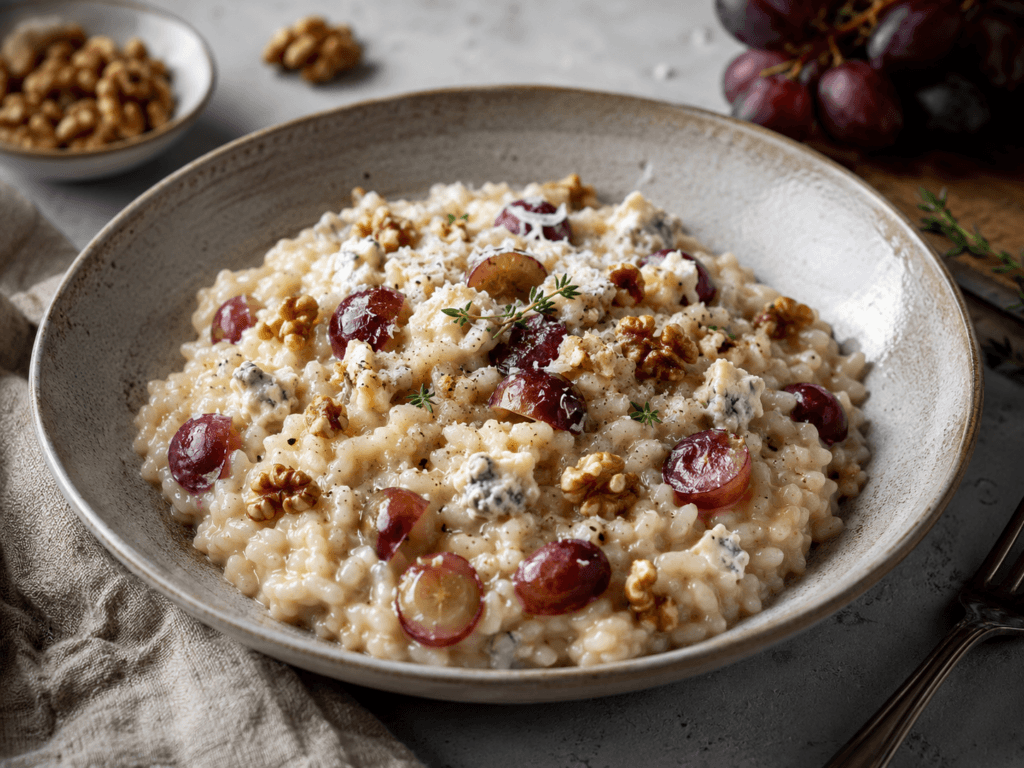
Grape Risotto with Gorgonzola and Walnuts
Sweet grapes, tangy cheese, and creamy rice: What sounds unusual at first makes for a wonderfully autumnal risotto.
For 4 people
320 g risotto rice 250 g red or dark seedless grapes 1 small onion or 2 shallots 2 tablespoons olive oil 100 ml dry white wine approx. 900 ml hot vegetable soup 100 g Gorgonzola 40 g Parmesan, freshly grated 40 g walnuts 1 tbsp butter salt and black pepper a few sprigs of thyme
Preparation
Cut the grapes in half. Coarsely chop the walnuts and toast them briefly in a pan without oil.
Finely dice the onion or shallots and sauté them in olive oil over low heat until translucent. Add the risotto rice and toast it for one to two minutes. Deglaze with white wine and let it reduce until almost all the liquid has evaporated.
Now gradually add hot vegetable broth, stirring regularly and waiting until the liquid has been absorbed by the rice.
After about 12 minutes, fold in half of the grapes. When the rice is creamy but still slightly al dente, stir in the Gorgonzola, Parmesan, and butter. Season to taste with salt and pepper.
Serve with the remaining fresh grapes, walnuts, and a little thyme. It’s the contrast between the warm, soft grapes and the fresh, crisp ones that makes this risotto especially exciting.
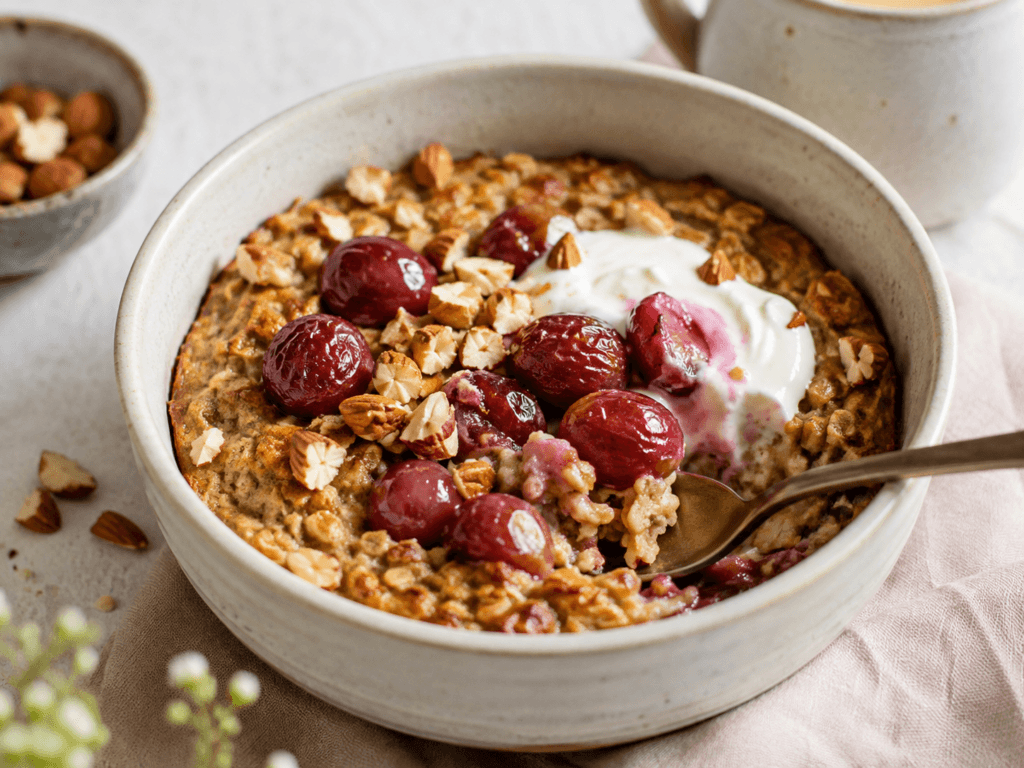
Oven-Baked Porridge with Roasted Grapes and Yogurt
When roasted, grapes become even sweeter and take on an almost jam-like quality. Combined with rolled oats and yogurt, they make for a breakfast that practically cooks itself in the oven.
Serves 2
120 g rolled oats 250 ml milk or plant-based milk 1 small ripe banana 1 egg 1 tsp cinnamon 1 tsp vanilla 200 g seedless grapes 2 tbsp chopped almonds 1 tsp honey 150 g plain or Greek yogurt
Preparation
Preheat the oven to 180 degrees Celsius (top/bottom heat).
Mash the banana with a fork and mix it with the rolled oats, milk, egg, cinnamon, and vanilla. Transfer to a small baking dish.
Arrange the grapes on top, press them lightly into the oatmeal mixture, and sprinkle with almonds. Bake for about 25 minutes, until the porridge is golden brown and the grapes are soft and have partially burst.
Serve while still warm with a dollop of yogurt and drizzle with a little honey to taste.
If you’re short on time in the morning, you can also bake the oven-baked porridge the night before and reheat it briefly the next day.
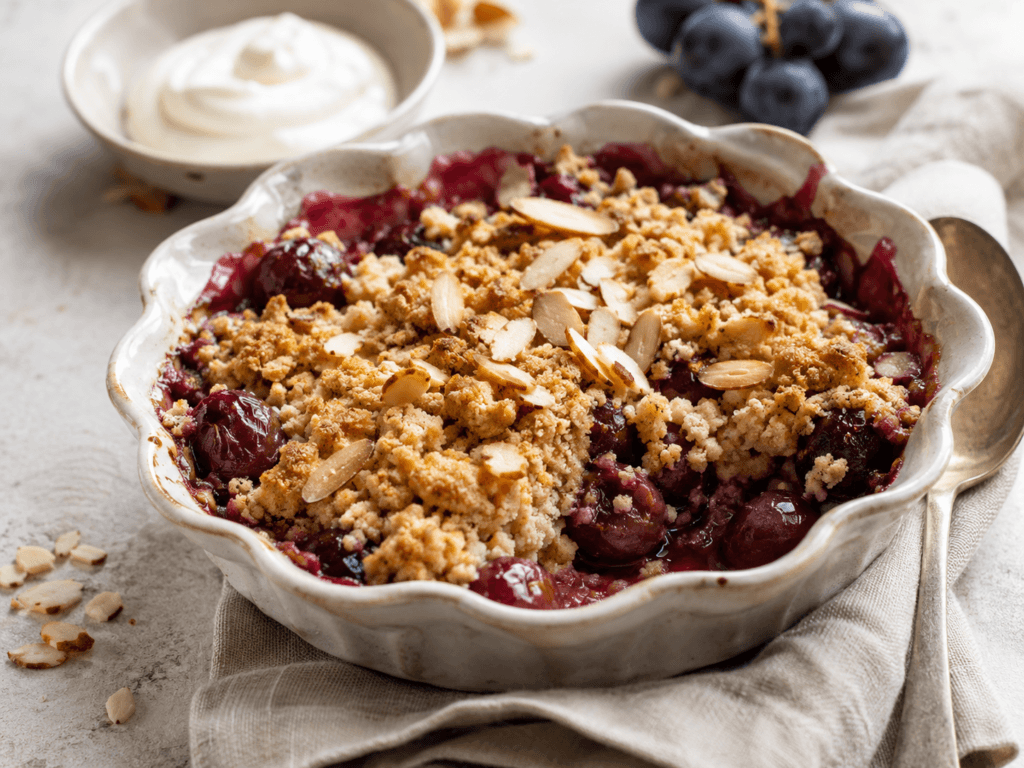
Grape Crumble with Almonds
Apples and plums are perfect for a crumble—so why not grapes? The fruit bursts open in the oven and combines with the crispy almond topping to create a simple fall dessert.
For 4 people
500 g seedless red or dark grapes 1 tbsp lemon juice 1 tsp vanilla sugar 80 g flour 60 g rolled oats 60 g cold butter 50 g brown sugar 40 g sliced almonds or chopped almonds 1 pinch of salt a little cinnamon
Preparation
Preheat the oven to 190 degrees Celsius (top and bottom heat).
Wash the grapes, pat them dry, and toss them with lemon juice and vanilla sugar. Place them in a small baking dish.
Use your fingers to rub the flour, rolled oats, butter, sugar, almonds, salt, and a pinch of cinnamon together into coarse crumbs, then spread them over the grapes.
Bake for about 25 to 30 minutes, until the crumble topping is golden brown and the grape juice is bubbling slightly around the edges.
Serve warm—plain, with Greek yogurt, or, for a less sensible option, with a scoop of vanilla ice cream.
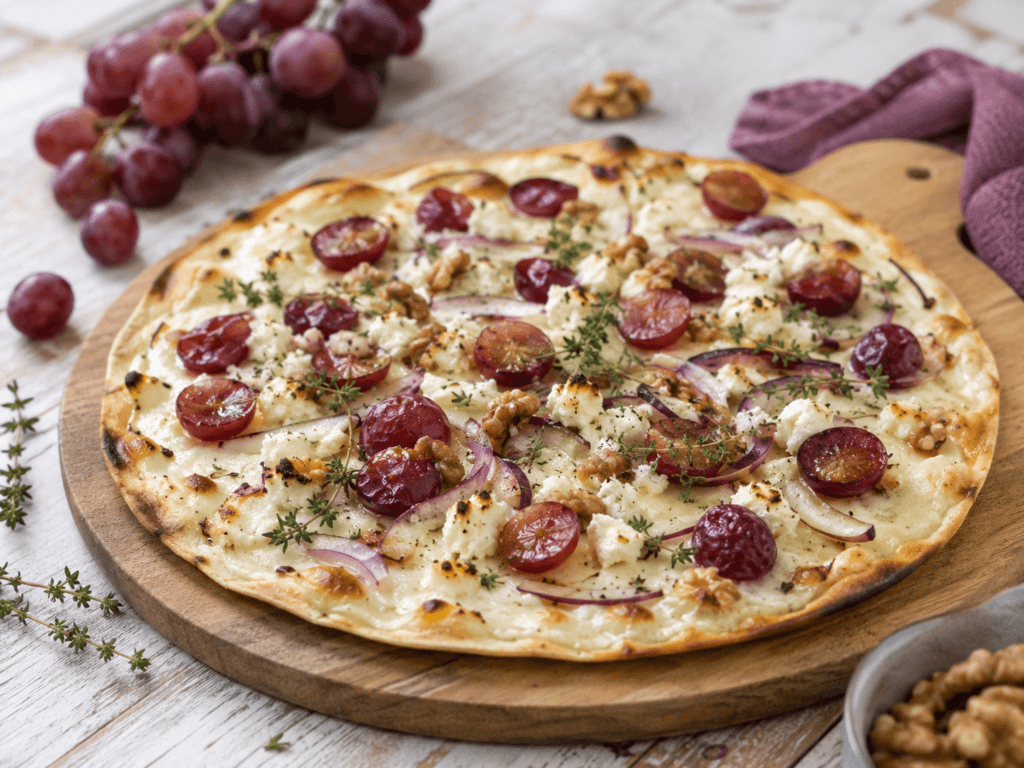
Tarte Flambée with Grapes, Goat Cheese, and Thyme
Grapes and cheese are a perfect match on a cheese platter. This combination works just as well—if not better—on a crispy tarte flambée.
Serves 2 to 3
1 tarte flambée dough 150 g crème fraîche 150–200 g seedless red grapes 120 g soft goat cheese 1 small red onion a few sprigs of thyme salt and black pepper optional: a few walnuts optional: 1 tsp honey
Preparation
Preheat the oven to as high a temperature as possible, between 220 and 240 degrees, using top and bottom heat.
Place the tarte flambée dough on a baking sheet lined with parchment paper and spread a thin layer of crème fraîche over it, leaving a small border around the edge.
Cut the grapes in half, slice the onion into very thin rings, and spread both over the dough. Crumble the goat cheese over the top and season with thyme, pepper, and a pinch of salt. If you like, add a few coarsely chopped walnuts.
Bake for about 10 to 15 minutes, depending on the dough, until crispy. Before serving, you can drizzle a few drops of honey over the top.
The result is sweet, salty, creamy, and crunchy all at once—and perhaps the best proof that grapes are far too good to be eaten only straight from the fruit bowl.
For a long time, white was considered a timeless and uncomplicated choice for the kitchen. But sage green, sand, terracotta, and dark blue are increasingly bringing warmth and personality to cabinet fronts. Which colors are suitable for the kitchen, how they transform the space, and what to consider when making your selection. For years, white …
Where does wine feel most at home in an apartment? Does it always have to be stored lying down? And how bad is a room temperature of 20 degrees, really? Master Sommelier Alexander Koblinger explains what matters most when storing wine at home—and why consistency is often more important than the perfect temperature. Not everyone …
Mild, crisp, and surprisingly versatile: kohlrabi is one of the most popular summer vegetables in Austria. Whether eaten raw, cooked, or roasted—this round tuber impresses with its delicate flavor, abundance of vitamins, and countless ways to prepare it. We’ll share what matters most when it comes to shopping for, storing, and preparing it. How do …
SIE WOLLENNICHTSMEHR VERPASSEN?
Unser kostenloser Newsletter liefert Ihnen wöchentlich die neuesten Artikel rund ums Wohnen & Leben.
SIE WOLLENNICHTSMEHR VERPASSEN?
Unser kostenloser Newsletter liefert Ihnen wöchentlich die neuesten Artikel rund ums Wohnen & Leben.
SIE WOLLEN
NICHTS MEHR VERPASSEN?
Unser kostenloser Newsletter liefert Ihnen wöchentlich die neuesten Artikel rund ums Wohnen & Leben.