

A beautiful teapot, fragrant tea leaves, and a few minutes just for yourself: drinking tea can be so much more than just a quick cup here and there. Inspired by centuries-old traditions from Japan and China, the tea ceremony becomes a small ritual even at home. We’ll show you how to do it, what accessories you’ll need, and what’s important when preparing tea.
The kettle clicks, the tea steeps in the background while you reply to the next few emails. That’s often what drinking tea looks like in everyday life. But you can turn a simple cup of tea into a little experience. One that’s not just about the taste, but also about beautiful objects, mindful gestures, and the joy of taking a few minutes for yourself.
In Japan and China, the art of tea preparation has been deeply rooted in the culture for centuries. And here, too, interest is growing in approaching everyday habits with greater mindfulness. A tea ceremony at home doesn’t have to be complicated at all. Even just a handmade ceramic bowl, a good quality tea, and a quiet spot can make all the difference. Because sometimes it’s the simple things that make a moment special.
How does a tea ceremony work?
When you think of a tea ceremony, you might picture Japanese tea houses, artfully arranged utensils, and strictly defined sequences of movements. In fact, traditional ceremonies do follow certain rules and hold deep cultural significance. At home, however, things can be much simpler.
It all starts with preparation. Clear a small table, set out the teapot, and choose a suitable variety of tea. Perhaps add a nice tray, a simple vase with a single twig, or a candle. The point isn’t to decorate as much as possible, but to create a pleasant atmosphere.
Next, fresh water is heated to the appropriate temperature. While it’s heating up, you can already start observing the tea: What do the leaves look like? How do they smell? Does their aroma change as soon as they come into contact with the hot water?
The teapot is preheated, the tea is brewed, and after the recommended steeping time, it is poured into bowls or cups. Instead of reaching for your cell phone right away, take a moment to consciously appreciate the color, aroma, and flavor.
Does that sound unspectacular? That’s exactly what makes it so appealing. A simple sequence of repetitive gestures can help you put everyday life on the back burner for a few minutes.
What do you need for a tea ceremony at home?
The good news: An elaborate tea set isn’t necessary. Much more important are a few carefully selected items that you enjoy using.
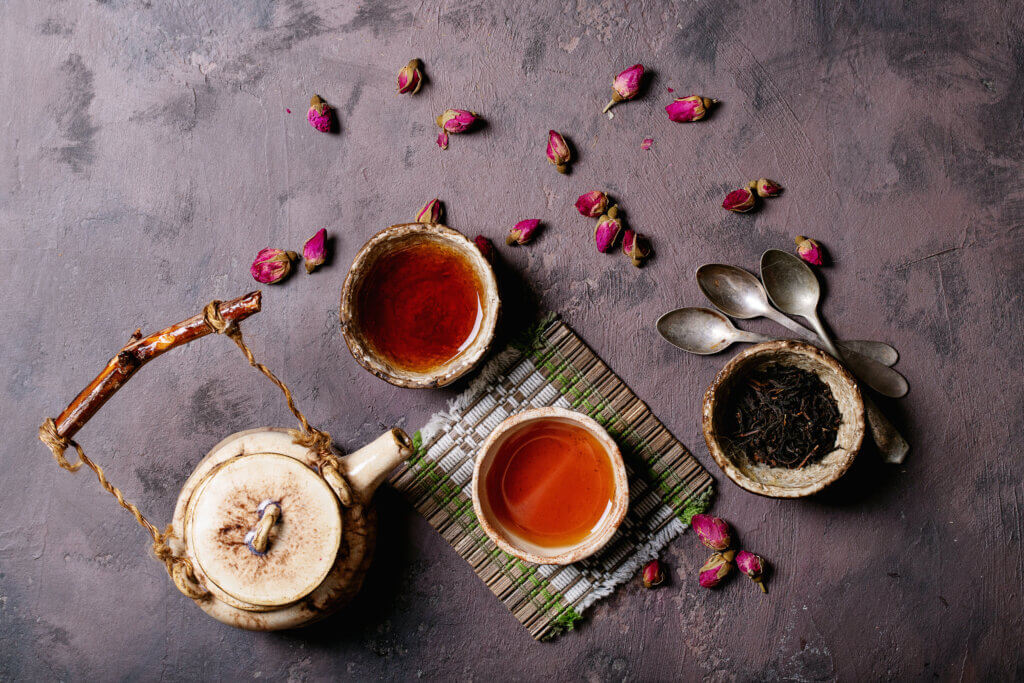
A teapot takes center stage. Porcelain, glass, or ceramic teapots are particularly well-suited for this purpose. While glass allows you to see the tea leaves unfurling, handmade ceramic teapots add a warm, personal touch to the table.
Small tea bowls are ideal for this, allowing you to savor the tea in several sips. Those who wish to follow Japanese tradition more closely can use a matcha bowl and a bamboo whisk, known as a chasen. For the Chinese method of preparation, a gaiwan—a small teapot with a lid—is ideal.
A kettle with a temperature control is also handy, since different types of tea require different water temperatures. A tea strainer, a small container for storing tea leaves, and a tray round out the set.
The surroundings also play a role. A linen tablecloth, a beautiful wooden surface, subtle colors, and pleasant lighting create a setting that invites you to linger. Natural materials such as wood, stone, and ceramics create a particularly harmonious atmosphere.
And if you’d like to share the moment with someone, just set out a second cup. After all, a tea ritual can be just as much a little break for yourself as it is a lovely shared tradition.
Which tea is best suited for a tea ritual?
In general, almost any high-quality tea can be savored mindfully. However, loose-leaf teas are particularly interesting, as their aroma and flavor can fully develop during preparation.
Green tea is a popular choice for anyone who appreciates light, fresh, and sometimes grassy or nutty notes. Japanese sencha, for example, is well-suited for a brief morning tea ritual. High-quality gyokuro also offers a special taste experience, though it requires a bit more care during preparation.
Matcha holds a special place. Unlike regular loose-leaf tea, this finely ground green tea powder is not steeped and strained, but rather whisked with water using a bamboo whisk. Its intense green color and unique preparation method make it a popular component of Japanese-inspired tea rituals.
Those who prefer stronger flavors should choose black tea. Oolong, on the other hand, falls between green and black tea in terms of processing and, depending on the variety, delights with floral, fruity, or roasted notes. Oolong, in particular, is ideal for multiple infusions, during which the flavor gradually changes.
White tea is also a lovely choice. It is processed relatively gently and is often characterized by delicate, subtle flavors.
Decaffeinated herbal or fruit infusions are perfect for an evening ritual. Strictly speaking, they aren’t tea in the botanical sense, since they don’t come from the tea plant. Still, they can be a wonderful alternative for a cozy way to end the day.
How long and at what temperature should tea steep?
The correct water temperature and steeping time are key to the flavor. Water that’s too hot can make delicate teas unpleasantly bitter, while a steeping time that’s too short may not bring out the desired aroma.
As a guide for traditional preparation, the following values apply:
- Green tea: about 70–80 °C, 1–3 minutes
- White tea: about 75–85 °C, 2–5 minutes
- Black tea: about 90–100 °C, 3–5 minutes
- Oolong tea: depending on the variety, about 80–95 °C, 2–4 minutes
- Herbal and fruit teas: generally pour boiling water over them and let them steep according to the package instructions, often 5–10 minutes
These guidelines are approximate. Especially with high-quality teas, the recommendations can vary significantly depending on origin, processing, and the desired intensity of flavor. For herbal and fruit teas, the manufacturer’s preparation instructions should be followed, also for hygienic reasons.
For a successful tea ritual, it’s worth experimenting with small amounts. Even a few degrees difference in temperature or half a minute longer steeping time can alter the flavor experience.
The Chinese Gongfu method follows different rules altogether: Here, a relatively large amount of tea leaves is steeped multiple times with a small amount of water, each time for only a short while. This allows you to discover the various flavor nuances of a particular variety particularly well.
A quick tip: If you want to truly savor the tea, be sure to completely separate it from the leaves once the steeping time is up. If the leaves remain in the water, the flavor can sometimes change significantly.
What is the difference between Japanese and Chinese tea ceremonies?
Although both traditions have a long history, they differ in their structure and sequence of events.
The Japanese tea ceremony, also known as Chanoyu or Chado, is closely associated with the preparation of matcha. Over the centuries, it has evolved into a unique form of hospitality in which every gesture holds significance. Harmony, respect, purity, and inner peace are among its core principles.
The choice of teacup, the arrangement of the utensils, and even the seasonal decorations are all carefully coordinated. It’s not just about drinking tea, but about paying attention to the moment shared together.
Chinese tea culture is remarkably diverse. One well-known method of preparation is Gongfu Cha, in which loose tea leaves are steeped multiple times in small teapots or a gaiwan. What makes this particularly fascinating is how the aroma and flavor evolve with each subsequent infusion.
While the Japanese matcha ceremony focuses on established rituals and their cultural significance, Gongfu Cha places special emphasis on the careful preparation and sensory experience of various infusions. Both traditions have different variations and far more nuances than can be conveyed in a brief description.
At home, there’s no need to fully replicate either of these ceremonies. Instead, you can draw inspiration from their emphasis on ingredients, preparation, and hospitality.
Perhaps this will turn into a very personal ritual: trying a special type of tea every Sunday morning, consciously brewing a pot after a long day at work, or surprising guests with a small selection of teas instead of the usual coffee.
After all, it’s not the number of utensils or the perfection of the preparation that makes for a lovely tea moment. It’s the time you take for it.
FAQ: The 7 Most Common Questions About the Tea Ceremony at Home
A simple tea ritual takes just 10 to 20 minutes. Of course, if you’re trying different infusions or tasting several types of tea, you can take considerably more time.
Yes. A personal tea ritual is a wonderful way to take a little break. The focus is on mindfully preparing the tea and then savoring it.
No. A regular teapot made of porcelain, glass, or ceramic is perfectly sufficient. For certain traditional brewing methods, specialized vessels such as a gaiwan or a matcha bowl may be useful.
Yes, many high-quality loose-leaf teas are suitable for multiple infusions. Oolong and Pu-erh, in particular, are often brewed multiple times. The temperature and steeping time should be adjusted according to the specific variety.
A gaiwan is a traditional Chinese tea vessel consisting of a bowl, a lid, and often a saucer. It is particularly well-suited for brewing loose-leaf tea in several short infusions.
If you’d like to avoid caffeine in the evening, you can opt for decaffeinated herbal or fruit infusions. Classic green, black, white, and oolong teas, on the other hand, naturally contain caffeine.
A tidy space, beautiful tableware, pleasant lighting, and natural materials are often all that’s needed. It’s especially important to avoid being distracted by your cell phone or other activities while drinking tea.
Similar posts:
Dehydrating—Everything You Need to Know
The Green Moment—How to Make the Perfect Matcha