Preventing Legionella: Causes, Risks, and Protection
3. August 2026
5 Mins read
We keep hearing about Legionella bacteria contaminating drinking water. In Austria alone, 419 cases of illness caused by the bacteria were reported last year.
What are Legionella bacteria, and how do they form?
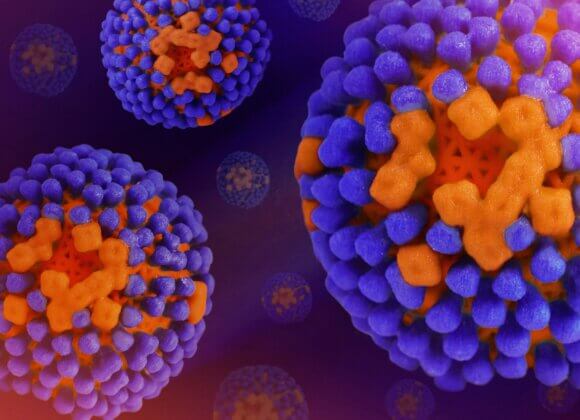
“Legionella are rod-shaped bacteria,” says Martin Taschl, secretary general of the Forum Wasserhygiene. These environmental bacteria occur naturally in small numbers in water and in moist environments such as damp soil, potting mix for houseplants, humus, and compost.
How dangerous is Legionella in the home?
Legionella bacteria are generally not dangerous in the home. However, they become a hazard when they multiply rapidly. According to the EU Drinking Water Directive, the limit in this context is 100 colony-forming units per 100 ml of water—a standard that has long been established in Austria.
What many people don’t know: “The water is safe to drink even if it contains high levels of Legionella,” explains Taschl. That’s because when Legionella bacteria enter the stomach, they are destroyed by stomach acid. However, it becomes dangerous whenever a large amount of finely atomized, misted water is inhaled. “This happens when showering, in a hot tub, or when using air conditioners and humidifiers,” says the water hygiene expert. If the bacteria enter the lungs in this way, they can cause two diseases: Legionnaires’ disease (legionellosis), a form of pneumonia, and Pontiac fever, which is usually mild.
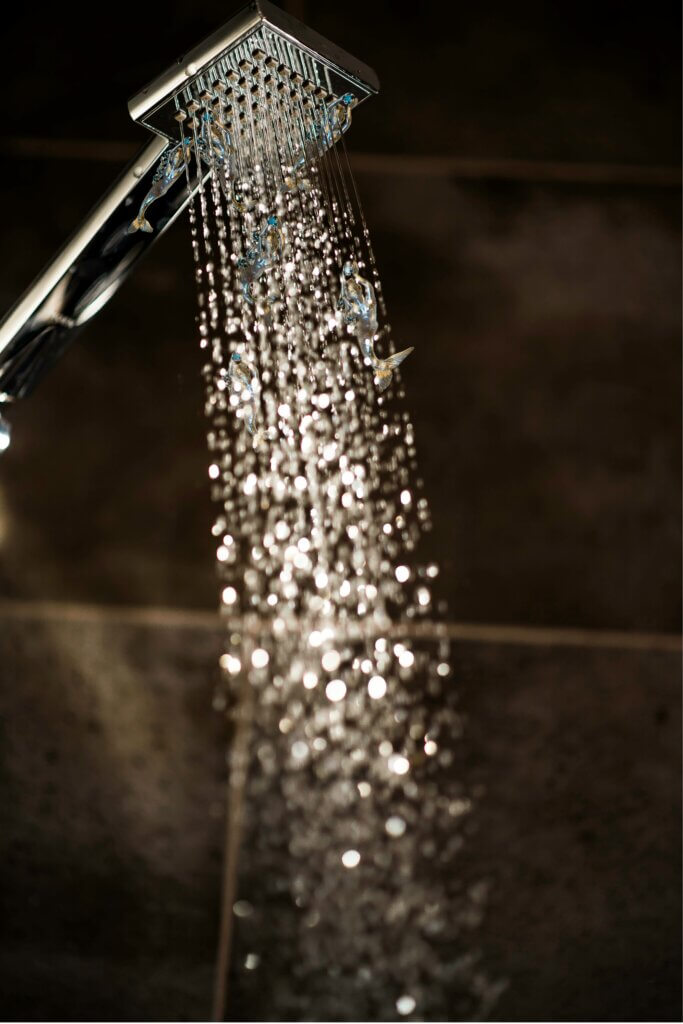
Legionella Risk: If the shower hasn’t been used for a while, you should let the stagnant water drain out.
What are the symptoms of a Legionella infection?
Legionellosis (Legionnaires’ disease) presents with chest and headaches, cough, chills, and high fever. Abdominal pain accompanied by diarrhea and vomiting may occasionally occur. Pneumonia is often severe and, despite the availability of effective antibiotic treatment in Austria, is fatal in 10 to 15 percent of cases.
Pontiac fever, which is considerably less dangerous than Legionnaires’ disease, occurs much more frequently. Typical symptoms include flu-like symptoms such as fever, malaise, headache, and body aches; chest pain and coughing are also possible. The illness typically resolves on its own within two to five days without medical treatment.
At what water temperature do Legionella bacteria multiply?
Legionella bacteria multiply best at water temperatures between 30 and 45°C. “We often see the latter in our drinking water systems,” says Taschl. This is partly because the temperature at the boiler or water heater is turned down, or because these systems are shut off completely—for example, during a vacation. Additionally, cold-water pipes can heat up to 29 degrees Celsius or even higher during the summer heat. “Hot water temperatures that are too low and cold water temperatures that are too high are the biggest risk factors for Legionella growth,” explains Taschl. The danger is exacerbated when the water sits in the pipes for an extended period—that is, when the faucet isn’t turned on.
How can you prevent Legionella in the hot water system?
The best way to prevent the growth of Legionella bacteria is to maintain a sufficiently high temperature in the hot water supply. “The recommendation is at least 55 degrees,” says Taschl. It is also important to insulate the cold-water pipes. Unlike hot-water pipes, the goal with cold-water pipes is not energy efficiency. This helps prevent them from getting too hot. A temperature below 20 degrees is considered ideal for cold water, as Legionella bacteria do not multiply at this temperature. The Drinking Water Ordinance specifies a maximum of 25 degrees. However, even the best insulation cannot prevent the water from heating up—it can only delay it. Therefore, the water pipes in houses and apartments must also be used regularly. “After a prolonged absence, you should especially let the shower run for an extended period—first the hot water and then the cold water. Meanwhile, you should leave the bathroom and, if available, open the window,” advises Taschl. Humidifiers and air conditioners, on the other hand, should be cleaned or serviced regularly.
Which buildings and water systems are particularly at risk?
Large buildings with extensive plumbing systems—such as hospitals, nursing homes, schools, hotels, wellness centers, or large residential complexes—are particularly at risk. However, even in single-family homes, Legionella bacteria can, under certain circumstances, multiply to potentially harmful levels.
Is Legionella in rental apartments the tenant’s problem or the landlord’s?
The answer to this question is: It depends. According to tenancy law, the landlord is responsible for the water pipes in the wall, while the tenant is generally responsible for the use of the faucet. “It becomes particularly difficult if Legionella bacteria have multiplied because the tenant hasn’t used the water regularly. If the water is still clean at the point of delivery, the landlord isn’t to blame for the contamination,” says the secretary general of the Water Hygiene Forum.
How often must a Legionella test be conducted in Austria?
Currently, there is still no general legal requirement in Austria to have water tested for Legionella. “Austria has not yet implemented the EU Drinking Water Directive on this point, but that will change by 2029,” says Taschl. For the time being, mandatory testing by the authorities is still determined by official notice. “However, this generally only applies to lodging establishments, as well as nursing homes and hospitals,” says Taschl. Residents of residential buildings—with the exception of individual apartments, single-family homes, and two-family homes—need not worry about the quality of their water, however: Regular testing for Legionella has been standard practice there for years, and such tests should be conducted at intervals of one to four years. “Unfortunately, that’s not always the case,” says Taschl.
There is currently no legal requirement in Austria to have the water in residential buildings tested for Legionella.
What should you do if Legionella bacteria are detected in drinking water?
If a case of Legionnaires’ disease is diagnosed, the property management company, the landlord, or the owner must be notified. If the hospital does not already do so, the head of the household must also notify the authorities of the illness. Until the matter is fully resolved, the landlord should definitely alert all other tenants to the potential risk posed by Legionella.
But measures are also being taken to combat the bacteria: “To kill them, the pipes are flushed with hot water. To do this, the hot water is heated to at least 70 °C whenever possible, and each faucet is thoroughly flushed,” explains Taschl. If this isn’t possible for technical reasons—for example, in cold-water pipes or older buildings—chemical treatments are used.
Does the risk of Legionella increase in the summer due to higher temperatures?
As summers continue to get warmer, the risk is increasing that cold-water pipes will reach temperatures that promote the growth of Legionella. “But longer absences due to vacations also contribute to this,” says Taschl.
Good to Know
In Austria, every case of illness and every death must be reported
Older people with weakened immune systems, those with chronic lung diseases, and smokers are at particularly high risk
Overall, more men than women contract Legionnaires’ disease, especially those aged 50 and older
Human-to-human transmission is not possible
Currently, more than 60 species of Legionella are known, almost all of which are classified as pathogenic. In Europe, most cases of Legionnaires’ disease are caused by Legionella pneumophila serogroup 1.
Preventing Legionella: Our Expert
Martin Taschl is the Secretary General of the Water Hygiene Forum
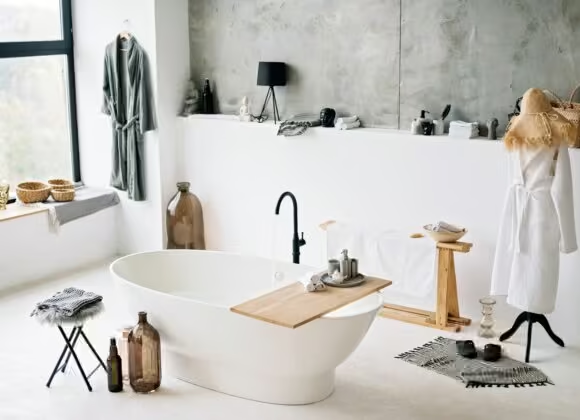
Seamless, minimalist, and surprisingly versatile: microcement has evolved from a minimalist architectural material into a popular alternative to traditional tiles. Interior designer Stefanie Winter explains where microcement can be used in the bathroom, what’s important when it comes to installation and waterproofing—and why the seemingly uncomplicated surface is best left to the professionals. Microcement is …
Natural light, plants, wood, and organic shapes: Biophilic design brings nature into our living spaces not just as decoration, but as an integral part of them. Especially in the city, this design style is intended to create a sense of calm, comfort, and a stronger connection to the natural environment. The longing for nature is …
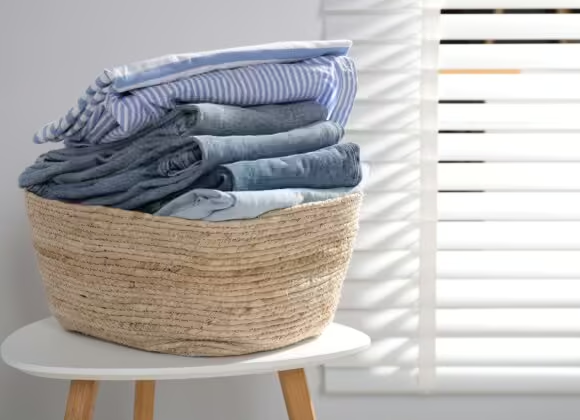
A good laundry basket is more than just a container for dirty laundry: the material, size, and craftsmanship determine whether laundry is stored hygienically or whether unpleasant odors develop. Combined with the right accessories—from clothespins to laundry bags—household chores become much easier. Here’s what really matters when buying a laundry basket and which materials have …
SIE WOLLENNICHTSMEHR VERPASSEN?
Unser kostenloser Newsletter liefert Ihnen wöchentlich die neuesten Artikel rund ums Wohnen & Leben.
SIE WOLLENNICHTSMEHR VERPASSEN?
Unser kostenloser Newsletter liefert Ihnen wöchentlich die neuesten Artikel rund ums Wohnen & Leben.
SIE WOLLEN
NICHTS MEHR VERPASSEN?
Unser kostenloser Newsletter liefert Ihnen wöchentlich die neuesten Artikel rund ums Wohnen & Leben.