

Summers are getting hotter, and air conditioning is going from a luxury to a standard feature. But like any piece of equipment, it will only deliver full performance while keeping energy consumption low if it is regularly maintained. Those who neglect maintenance end up paying twice: through their electricity bill and through the system’s shortened lifespan. We’ll show you what to look out for when maintaining air conditioning systems.
How often does an air conditioner need to be serviced?
“It is recommended to have an air conditioner serviced at least once a year,” says Hasan Saglam, managing director of TVG Klimatechnik GmbH. If the unit is used not only for cooling but also for heating—as is common with modern air-to-air heat pumps—it runs practically all year round. In this case, two maintenance visits per year should be scheduled.
According to the refrigeration expert, the ideal time is in the spring before the cooling season begins, and, if necessary, in the fall before the heating season. “Specialty companies have more capacity during these seasons. If you wait until it’s 35 degrees in July to call, you might have to wait weeks for an appointment,” says Saglam. His tip: A maintenance contract with a specialty company ensures fixed appointments, priority service in the event of a breakdown, and predictable costs.
Is there a mandatory maintenance requirement for air conditioning systems in Austria?
“In the residential sector, there is generally no legal obligation to maintain air conditioning systems,” says Saglam. The situation is different in the commercial sector: Here, depending on the amount of refrigerant used, the law requires regular leak checks by certified specialists, along with documentation in the system logbook. And private customers should also be aware that many manufacturers make their warranties contingent on proof of regular, professional maintenance. “In practice, annual maintenance is therefore a good investment even for private homeowners—if only to avoid losing warranty coverage,” the expert emphasizes.
What can I do myself when it comes to air conditioner maintenance?
If you want to do some of the work yourself, there are two tasks you can—and should—handle: cleaning or replacing the filters in the indoor unit, and removing leaves and debris from around the outdoor unit. Anything beyond that should be left to the professionals.“Working on the refrigeration circuit yourself is absolutely off-limits. Only certified specialist companies with the appropriate certificate of competence are permitted to perform this work,” Saglam clarifies. This is not only a matter of safety but is also required by law.
When should you call a technician for air conditioning maintenance?
Whenever the refrigerant circuit is involved, such as during a leak test. This test checks whether refrigerant is escaping into the atmosphere through a fine hairline crack. In addition, there are clear warning signs that require immediate professional attention: water leaking from the indoor unit, ice buildup on the outdoor unit, unusual noises, a musty odor, or a noticeable drop in cooling performance. “And, of course, if an error message appears,” says Saglam. Anyone who ignores these signs risks turning a minor, easily fixable issue into costly compressor damage.
How much does it cost to maintain an air conditioner in Austria?
According to Saglam, maintenance for a single-split system—that is, one indoor unit and one outdoor unit—typically costs between 250 and 350 euros. The more indoor units are connected, the higher the price will be, given the increased time required. Maintenance contracts with fixed intervals often offer discounted rates as well.
Which filters do I need to clean in my air conditioner, and how?
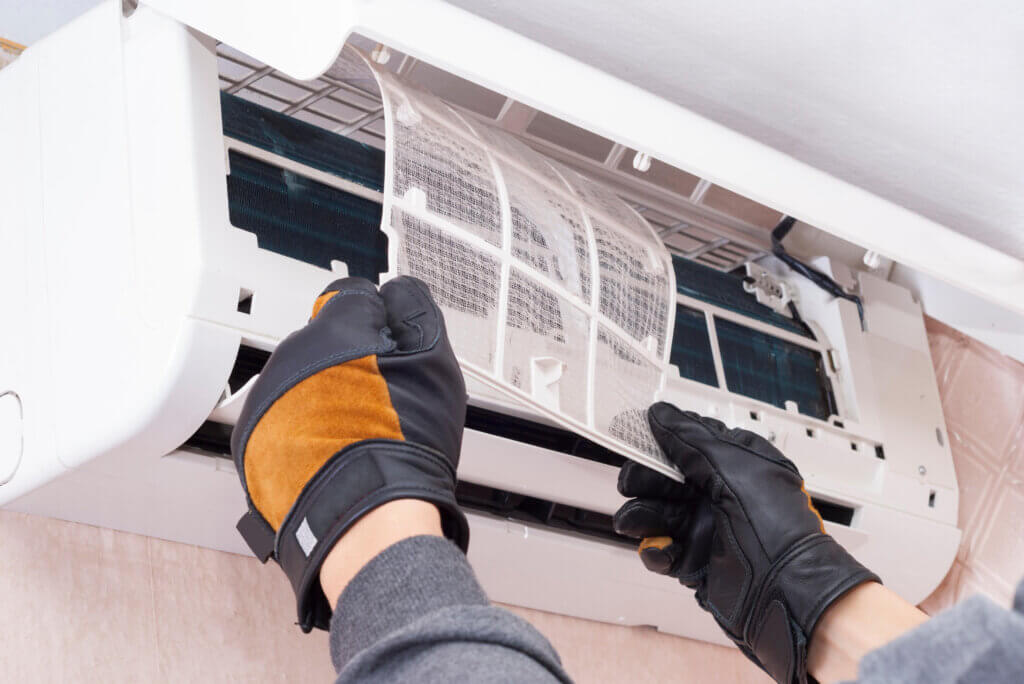
As a general rule, it is the coarse dust filter that should be cleaned regularly—ideally every two to four weeks during peak season. To do this, open the front flap, remove the filter, and vacuum it. If it is very dirty, it can also be rinsed with lukewarm water. “It’s very important to let the filter dry completely before reinserting it. A damp filter is an ideal breeding ground for mold,” advises Saglam. The situation is different for the activated carbon or fine dust filters that are additionally installed in some units: These cannot be cleaned and must be replaced according to the manufacturer’s instructions. The appropriate original filters are available from a specialist retailer.
What happens if you don’t maintain your air conditioner?
A lack of maintenance has multiple negative consequences. Dirty filters and heat exchangers reduce performance while significantly increasing electricity consumption. “That can amount to 15 to 25 percent more energy consumption—a real cost factor given today’s electricity prices,” says Saglam. Air quality—and thus health—can also suffer: Damp filters and deposits provide a breeding ground for mold and bacteria, which are then distributed throughout the room via the airflow. And last but not least, there is a risk of subsequent technical damage. A dirty heat exchanger forces the compressor to operate at maximum capacity continuously, causing the system’s most expensive component to age much more rapidly. If damage occurs, the manufacturer’s warranty is usually void without proof of maintenance. “A well-maintained system consumes significantly less electricity, lasts longer, and saves on expensive repairs. Calculated over its lifetime, maintenance is the most cost-effective insurance you can get for your air conditioner,” says the TVG managing director.
How do I properly clean the outdoor unit of my air conditioner?
“The most important thing is to make sure the heat exchanger at the back of the outdoor unit isn’t blocked or covered,” says Saglam. Leaves, grass, pollen, and dirt that accumulate there should therefore be removed regularly, preferably with a soft brush or carefully with a vacuum cleaner. The housing can also be cleaned if necessary. However, one device is strictly prohibited: the pressure washer. “The powerful water jet bends the heat exchanger’s delicate aluminum fins. Once the fins are bent, air can no longer flow through unimpeded, and performance drops permanently,” warns the refrigeration technician, who advises leaving the thorough cleaning of the heat exchanger—for example, with special fin cleaners—to a professional service provider as part of the annual maintenance.
Does the air conditioner need to be serviced before winter?
In general, the timing of maintenance is up to the individual. For those who use the unit exclusively for cooling, having it serviced in the spring is ideal, as this ensures the system starts the summer season reliably and efficiently. However, if the air conditioner is also used for heating, an additional service before the heating season is recommended. “In heating mode, the outdoor unit runs at full capacity in all kinds of weather. You want to be sure that everything is clean, airtight, and properly adjusted,” says Saglam.
Do portable air conditioners also need to be serviced?
Yes and no. Mobile units have a hermetically sealed refrigeration cycle, so traditional refrigeration cycle servicing is generally not required. “But whatshould definitely be done on a regular basis is cleaning the filter,” says Saglam. In addition, the condensate tank should be emptied regularly, and the device should be stored in a dry, dust-free place before being put into winter storage.
Air Conditioning Maintenance: What You Need to Know
- Professional air conditioning maintenance typically includes: Functional and visual inspection, leak test of the refrigeration circuit, checking operating pressures and temperatures, cleaning and disinfecting filters and heat exchangers, replacing filters if necessary, checking the condensate drain, replacing wear parts, and documenting the work in the system logbook or inspection log.
- Important to know: Refrigerant is not a consumable. A leak-free system does not lose refrigerant. Refrigerant is only replenished if a leak has been found and properly repaired.
- Before placing an order, compare the scope of services included in the quotes. The lowest price is of little use if key requirements are missing.
- When buying a new appliance, it’s worth looking into hygiene and self-cleaning features such as FrostWash: They reduce the effort required for cleaning and ensure better air quality over the long term.
- Regular maintenance is key to the system’s efficiency, hygiene, and longevity, and ensures that the manufacturer’s warranty remains valid.
Anyone looking to buy a new air conditioner or replace an existing one can find the right solution for virtually any living situation today:
• Split-system air conditioners for houses and apartments*
• Portable air conditioners for flexible cooling*
*Disclaimer: Links marked with * are affiliate links. If you buy something via these links, MYHOME.AT receives a commission. There are no additional costs for you.
Our expert

Related posts:
Optimally cooling an attic apartment: 7 tips
So the apartment remains pleasantly cool