
Will you soon be sharing your life, and therefore your four walls, with man’s best friend? Then congratulations on your decision: The arrival of a furry friend is an incredible enrichment. However, for a dog to really feel at home, it needs affection, patience, consistent training and species-appropriate care. This not only includes the right food and exercise, you should also furnish your home in a dog-friendly way .
How can I make my home dog-friendly?
In order for your dog to feel really comfortable in its new four walls, it doesn’t need too much in principle: the basic equipment for dog-friendly furnishings definitely includes a food and water bowl. They should be easy to clean, ideally not breakable and appropriate to the size of your four-legged friend.
Place both bowls in a quiet corner in a fixed place to allow the new roommate to eat and drink undisturbed. To prevent the bowls from sliding around the room, make sure they are placed on a non-slip surface.
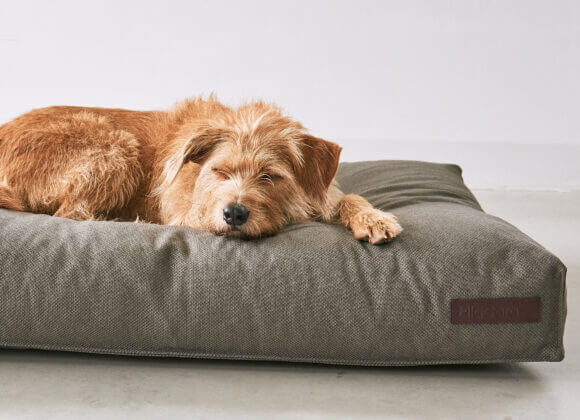
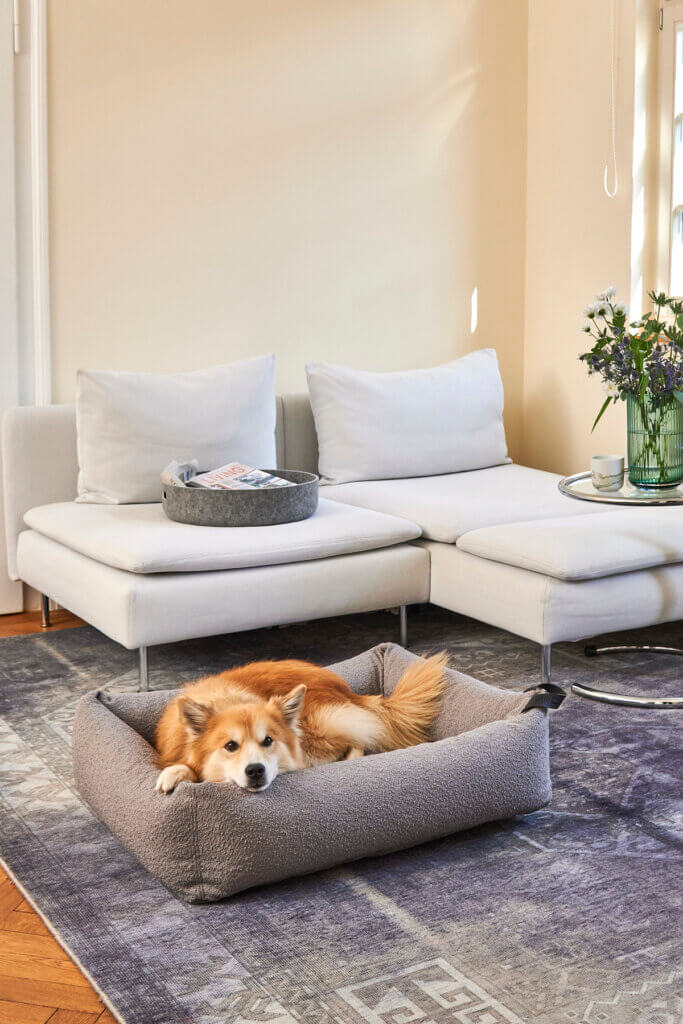
The four-legged friend also wants a comfortable place to sleep. The preferences for this vary greatly: Some are happy with a soft blanket, others prefer a soft dog sofa with raised sides. Others prefer to sleep in a dog cave or dog crate. Check occasionally whether the dog bed still meets the needs of the four-legged friend: older dogs or those with joint problems as well as pets with house dust allergies are clearly better off with special sleeping areas.
With this basic equipment, supplemented by dog toys, you are already in a good starting position on the way to a dog-friendly home. But for your dog to feel really at home within your four walls, it needs something else – lots of affection.
Which furniture is suitable for a dog-friendly home?
In principle, all furniture is suitable for living with a dog. When it comes to the four-legged friend itself, there are only two requirements: Dog beds, baskets and the like should be comfortable and easy to clean. However, because owners are increasingly attaching importance to design, and not just for their own furniture, there are now various suppliers that meet these criteria. Design does not only refer to the beds and baskets mentioned above, but also to food and water bowls or containers for dog food. Sustainability is also playing an increasingly important role in this context: materials that contain little or no harmful substances are therefore just as much in demand as high-quality fabrics. These should be robust and durable, but ideally also water-repellent.
Which materials are ideal if you want to furnish your home in a dog-friendly way?
If you share your home with a four-legged friend, you should choose hard-wearing and easy-to-clean materials such as microfiber. When it comes to removing dirty paw prints, a tiled or laminate floor is much easier to clean than parquet. However, a carpet can protect it from dirt and scratches caused by dog claws.
Where is the best place to set up the sleeping area in a dog-friendly home?
Dogs spend two thirds of the day and therefore most of their lives resting, dozing or sleeping. In view of this, dog owners should choose a sleeping area where their four-legged friend can do this undisturbed, but still not be separated from his pack. A passageway is therefore less suitable than a quiet corner in the home. There is also nothing wrong with offering your four-legged friend several places to retreat to. Draughts should also be avoided.
What else is needed for a dog-friendly home?
Safety plays a major role when it comes to dog-friendliness. If a puppy moves in, it may be advisable to secure power cables and sockets using special cable ducts or covers. Secure steep stairs, windows and balconies to prevent your four-legged friend from falling. Keep food, especially food that could harm the dog, cleaning agents and detergents, medicines and small parts that can be swallowed out of reach of your four-legged friend. Did you know, for example, that the increasingly popular birch sugar is deadly for dogs?
Well-sealed waste garbage cans prevent your animal roommate from using them. In addition, keep fragile objects out of its reach – this will prevent them from breaking and it from injuring itself on the shards.
Which plants are taboo in a dog-friendly home?
Various plants are also a major source of danger for man’s best friend. These include houseplants such as the dieffenbachia, the monocot, the window leaf, the ivy, the monstera or the yucca palm. But poinsettias, amaryllis or dragon and rubber trees are also included. There are also many plants in the garden that he considers poisonous, ranging from boxwood, ivy and cherry laurel to laburnum, rhododendron, oleander and yew, as well as monkshood, foxglove, lilies and lily of the valley.
How do I keep a dog-friendly home clean and tidy?
Regardless of whether you share your home with one or more four-legged friends – with a little organization, the four walls will stay clean. With a bucket of water and a towel at the front door, wet and dirty paws will be clean and dry in no time at all – if that doesn’t help, the four-legged friend will have to be put in the shower or bath.
A vacuum cleaner, ideally with a special pet hair brush, is also a good idea. Brushing your four-legged friend regularly can significantly reduce the amount of loose hair in the home. Apart from this, beauty care can also intensify the relationship between dog and owner.
And if you are one of those owners who share the sofa or bed with your pet, protect it with an easy-care blanket. When buying, also look out for hard-wearing covers that can withstand your furry friend.
Boxes, baskets, tins and other storage utensils keep things tidy – they can be used to store toys, soft toys, leads, harnesses and brushes, as well as food and treats.
But be aware: despite everything, you will have to make a few compromises in terms of tidiness and cleanliness when living with a dog.
Related posts:
Keeping pets is prohibited: I have these rights