Ever since a visit to the outdoor pool has become an epidemiological gauntlet, the dream of having your own pool has risen to the top of many people’s list of priorities. However, in addition to the not inconsiderable investment costs, there are also other things to consider. Especially legal ones! Together with our legal experts from HSP Rechtsanwälte, we will shed light on the potential stumbling blocks that await you, the obligations you enter into with a pool and what you need to bear in mind so that you don’t soon find yourself legally up to your neck in water.
Is there an authorization requirement?
Once you have thought carefully about the dimensions of your pool and where it is to be built, you need to clarify whether you will need a building permit for your project. You can find out about any conditions and requirements from the relevant building authority, as the building authority regulations vary from state to state. However, the pool companies themselves are often very good contacts in this area because they deal with the matter on a daily basis and can help you with many details.
Pool in Vienna
In addition to the depth (groundwater!), the need for a foundation and the planned dimensions of the pool, the location on the property also plays a decisive role. In Vienna, for example, the building regulations stipulate that the boundaries of the pool must be at least 3 meters away from the neighboring property. In addition, the total volume of the pool must not exceed 60 cubic meters and the top of the pool must not be more than 1.5 meters above the adjacent ground. If you can comply with all of these conditions without any problems, your project on building land is deemed to be exempt from approval and notification (§ 62a Para. 1 Z 22 BO for Vienna). If you cannot comply with the specifications, you will need a permit from the building authorities.
Not my reason. What now?
If you are not one of the lucky ones who live in your own house on your own property, there will certainly be other people who have a say in your pool. If the pool is built on an area that belongs to several owners, it is referred to as a common area. This means that an agreement must be reached for the construction of a swimming pool, i.e. each co-owner must agree to the construction project. In the area of application of the Condominium Act, the provisions of Section 16 WEG apply in particular. It states that the condominium owner is entitled to make changes (including changes of use!) to his or her condominium property at his or her own expense, but the paragraph also provides for further conditions if the property is a common area.
Traffic exercise
The phrase “exercise of traffic” refers to how common and established a construction project is in the surrounding region. So if several neighbors with similar requirements have also implemented a similar construction project, the project in question will also have a good chance. If this is not sufficiently proven, the owner can also plead an important self-interest that is fulfilled by the building project. At the same time, however, it must be ensured that the planned change will neither damage the building nor impair the interests of the other condominium owners that are worthy of protection. For the latter, a demonstrable, concrete danger of the project would also have to be evident, namely a danger to the safety of persons, the building or other property. Last but not least, all co-owners would have to agree on how to deal with the costs incurred, especially if, for example, water and electricity for the pool were to be drawn from the general supply.
Pool on lease and allotment garden association
Anyone who has rented a plot in an allotment garden association must first and foremost comply with the statutes of the respective association. If no explicit regulation is stated there, the Viennese allotment garden law generally applies in Vienna, according to which swimming pools and pools up to a total area of max. 25 m2 may be erected. If you have leased a plot of land, we also recommend that you first take a look at the lease agreement – if there is no corresponding provision, you must obtain permission from the lessor. And – as explained in the second paragraph – you must pay close attention to the building authority framework conditions.
However, the installation of inflatable paddling pools does not require a permit in any case – the only thing to bear in mind here is good cooperation, because if other tenants can also use the area, you must obtain permission from all co-users.
With a pool comes great responsibility
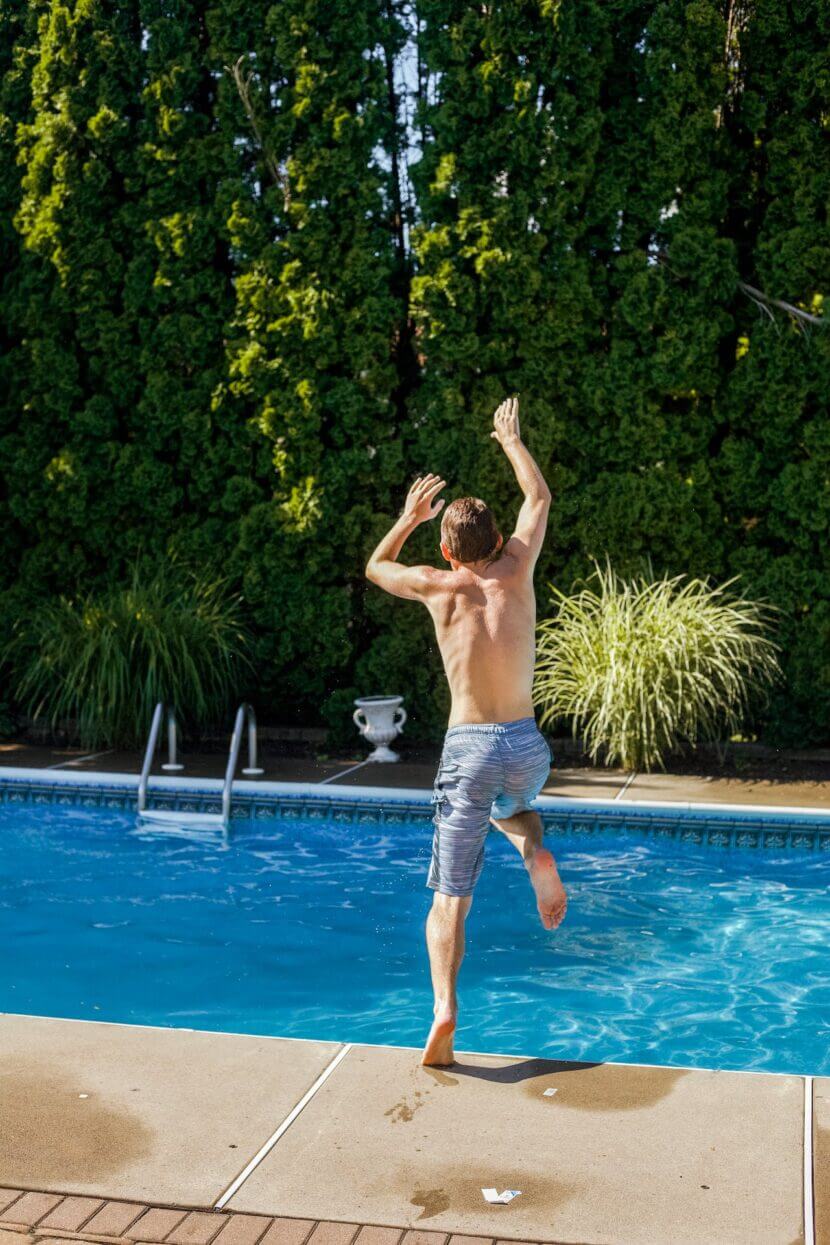
Whichever pool you finally decide on: As the owner of a swimming pool, you have above all created a source of danger that needs to be comprehensively protected. In other words: as the pool owner, you are subject to a duty of care and are responsible for ensuring that no one is harmed in your pool. Children in particular always underestimate the danger of swimming pools and should never be left unattended near water – this also applies to the smallest baby paddling pools.
For you, this means that if there are children living in the immediate vicinity who can easily enter the property and pool, you must take suitable precautions and safeguards to prevent them from entering your property and pool. The most suitable way to secure a system is best discussed with a specialist company – in general, however, it should be said that you should already allow for a security budget of several hundred, sometimes even several thousand euros when designing the pool.
If you violate your duty to maintain safety and another person is injured as a result, you may be held liable and liable for damages. In the worst case, there may even be criminal consequences.
The next summer is sure to come
Although the swimming season for 2020 is as good as over, now is exactly the right time to start planning your pool for next spring. As there are many decisions to make, many different pool types, filter systems and covers to weigh up, many potential companies to contact and many key points to consider, you may well need the time. And with a bit of luck, it will be pool ahoy next early summer!
Related posts: