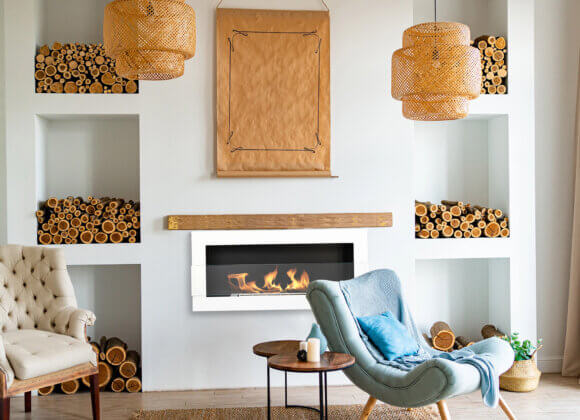
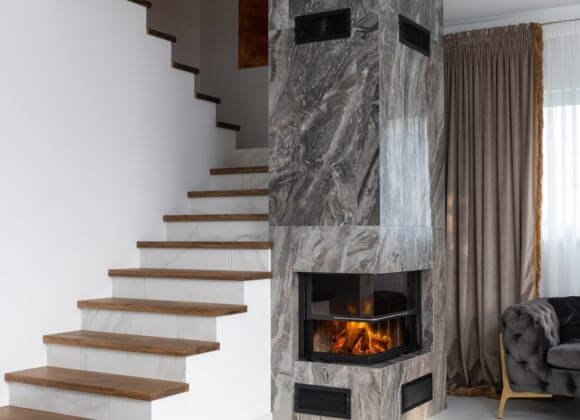
What could be nicer on a cold winter’s day than sitting down to a warming tiled stove? However, for the stoves to really live up to their reputation as sustainable heat sources, they need to be operated correctly. Thomas Schiffert, Managing Director of the Austrian Tiled Stove Association, reveals the best tips.
How do I heat the tiled stove efficiently?
The choice of the right fuel is crucial in order to obtain the maximum amount of heat from the fuel during the combustion process. The same applies to operation with as few emissions as possible. “The basis for this is that you only use dry wood for heating,” says Schiffert. Moist logs therefore have a lower calorific value – around a fifth of the energy stored in the wood is lost during combustion for the additional water evaporation.
But that’s not all: if damp wood is burned, flue gases are also formed. “The water content of firewood should therefore be a maximum of 20 percent and the moisture content a maximum of 25 percent. This value can be achieved by storing the wood outdoors for at least two years,” explains Schiffert.

Which types of wood are ideal?
According to Schiffert, both hardwood such as beech and softwood such as spruce can be used in tiled stoves. “The difference is that spruce is a third less dense than beech. This means you need more logs with spruce wood to reach the desired temperature,” explains Schiffert. Tiled stoves and wood-burning stoves are no longer only heated with logs, but increasingly also with briquettes. “They are drier than wood, so you need ten to 15 percent less weight for heating,” says Schiffert.
What should never go in the oven?
To avoid harmful emissions, both logs and briquettes should always be untreated. For this very reason, chipboard, wooden crates, waste paper, household waste or garden waste and other materials are also unsuitable as fuel.
How do you heat the tiled stove correctly?
For efficient and environmentally friendly operation, however, something else is needed in addition to untreated, dry wood, namely the right method for firing up the stove. And this calls for a rethink: “The top-down principle has become established for lighting the fire. Because fire burns from top to bottom and not the other way around,” explains Schiffert. In a first step, the logs are stacked crosswise – the thicker ones at the bottom and the thinner ones on top. Finally, the chips and the kindling are placed on top. “The latter should ideally also be natural, such as wood wool soaked in wax,” says Schiffert. Paper or liquid fire accelerants, on the other hand, are frowned upon as lighting aids.
In the next step, the air inlets are opened and the ignition aid is ignited, if not controlled automatically. After around ten to 15 minutes, the air supply can be reduced slightly. If only the basic embers are left, the air supply can either be topped up or, in the case of tiled stoves, completely shut off to store the heat.
How much wood should I put in the tiled stove?
“That depends on the respective heating load. You can find out how high this is from the stove fitter,” says Schiffert. This information can also be found in the operating instructions. Schiffert has another tip in this context: “You shouldn’t save on fuel. If you do, the temperature required for clean combustion will not be reached,” explains the managing director of the tiled stove association.
How often should you clean the tiled stove?
Modern tiled stoves produce practically no soot. The cold wood ash remaining in the combustion chamber of the stove! Wood ash should be removed once or several times per heating season, depending on the intensity of use. Apart from this, regular chimney cleaning by the chimney sweep is on the agenda. “We also recommend having the tiled stove serviced by a chimney sweep every two to five years, depending on how intensively it is used,” says Schiffert.
How can you tell if the tiled stove is being operated correctly?
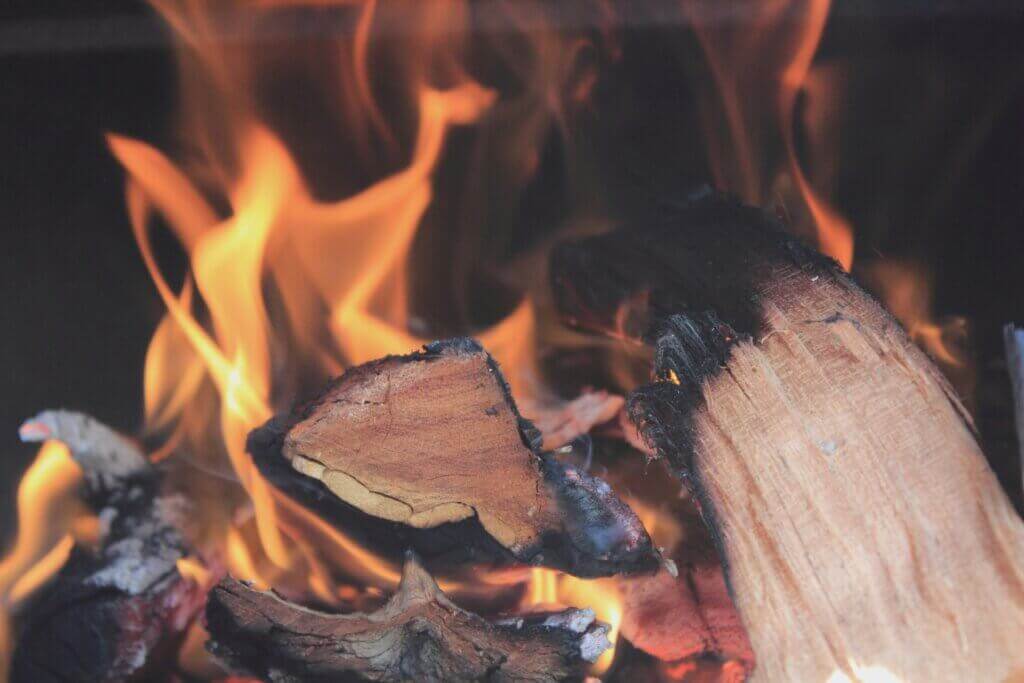
According to the Tiled Stove Association, there are clear indications of both clean and unclean combustion: Bright, high flames with no visible smoke and fine, light gray ash with no residue is an unmistakable sign of the former. Dark, sooty flames and sooty viewing windows as well as dark, coarse ash with charred wood residue, on the other hand, indicate that combustion is not taking place efficiently.
Our expert

TR DI Dr. Thomas Schiffert initially headed the testing and research institute of the Austrian Tiled Stove Association. In 2005, he finally took over the management of the entire association.
To the website: https://www.kachelofenverband.at
Related posts: