Designing a Mid-Century Bathroom: How to Achieve the Retro Look
21. September 2026
4 Mins read
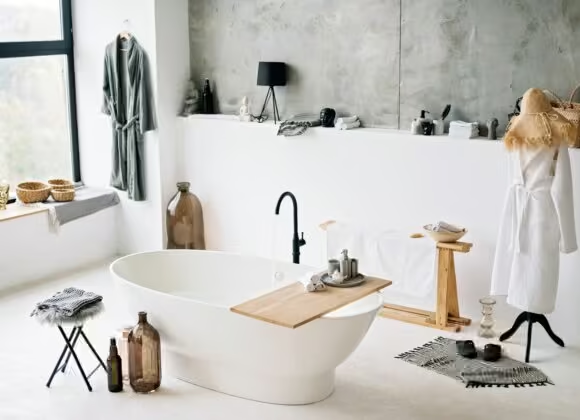
Simple, elegant, yet functional—these are the hallmarks of the mid-century style. That’s exactly why this style is becoming increasingly popular for bathrooms. In this post, you’ll find all the tips and inspiration you need to create a stunning mid-century bathroom.
What is the Mid-Century style?
, the Mid-Century style that emerged in postwar America, was and is characterized by clean lines, organic forms, and a lack of excessive ornamentation. The focus of the design was on the function of furniture—and of buildings as well—which was the decisive factor in their form. Popular materials for furniture, lamps, and other home furnishings included wood, veneer, vinyl, glass, acrylic, Plexiglas, and plastic; fabrics included velvet, corduroy, and bouclé, among others. These materials were not only used individually but were also frequently combined.
What colors are typical of a mid-century bathroom?
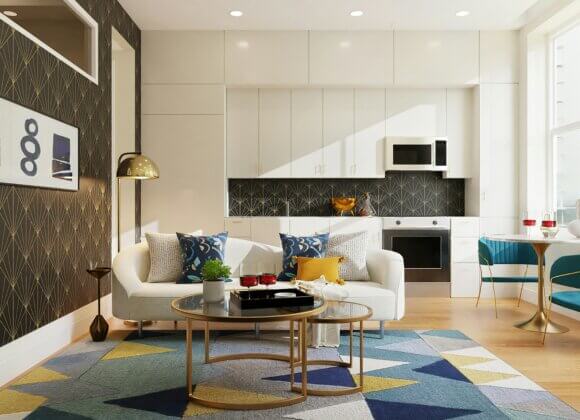
A Mid-Century bathroom is typically characterized by light, neutral base colors such as beige, greige, gray, or white, but also mustard yellow or terracotta. To avoid a monotonous look, contrasts in colors like blue, teal, green, as well as brown, orange, or black are recommended. Whether in the form of wallpaper or a tiled wall with a graphic pattern or herringbone design, or as the front of bathroom cabinetry. Speaking of tiles: Geometric tiles are also typical of a mid-century bathroom.
What fixtures and accessories are typical of a mid-century bathroom?
You won’t find whimsical fixtures and accessories in a mid-century-style bathroom. That’s because clean lines and simplicity are key here as well.
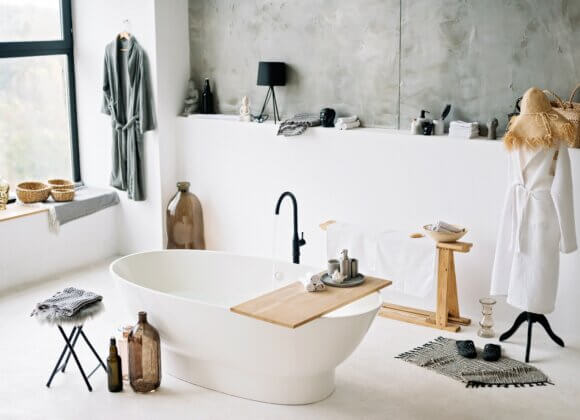
So avoid an excess of accessories, especially if the tile backsplash or a wall with geometric wallpaper already makes a statement on its own. A simple ceramic or wooden soap dish, a matching soap dispenser, and one or more plants are probably enough.
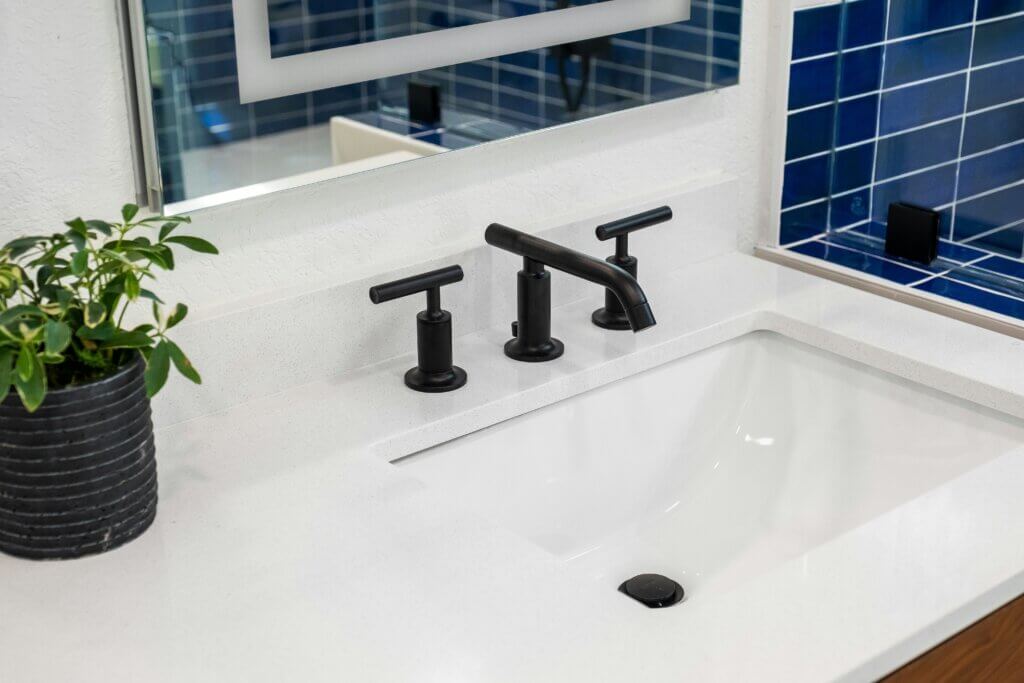
Clean lines also dominate mid-century-style fixtures.
How do I combine mid-century elements with modern plumbing fixtures?
The mid-century style thrives on contrasts in materials and colors. That’s why it’s perfectly fine to combine mid-century elements with modern bathroom fixtures—especially when those fixtures also feature simplicity and elegance.
What wood tones and materials go well with a mid-century bathroom?
The mid-century style favors warm tones—even when it comes to wood. That’s why wood in honey tones—with an elegant grain—is in demand! Materials such as plastic, glass, plexiglass, acrylic, and chrome also have a place in the mid-century bathroom.
How do I design a small bathroom in the mid-century style?
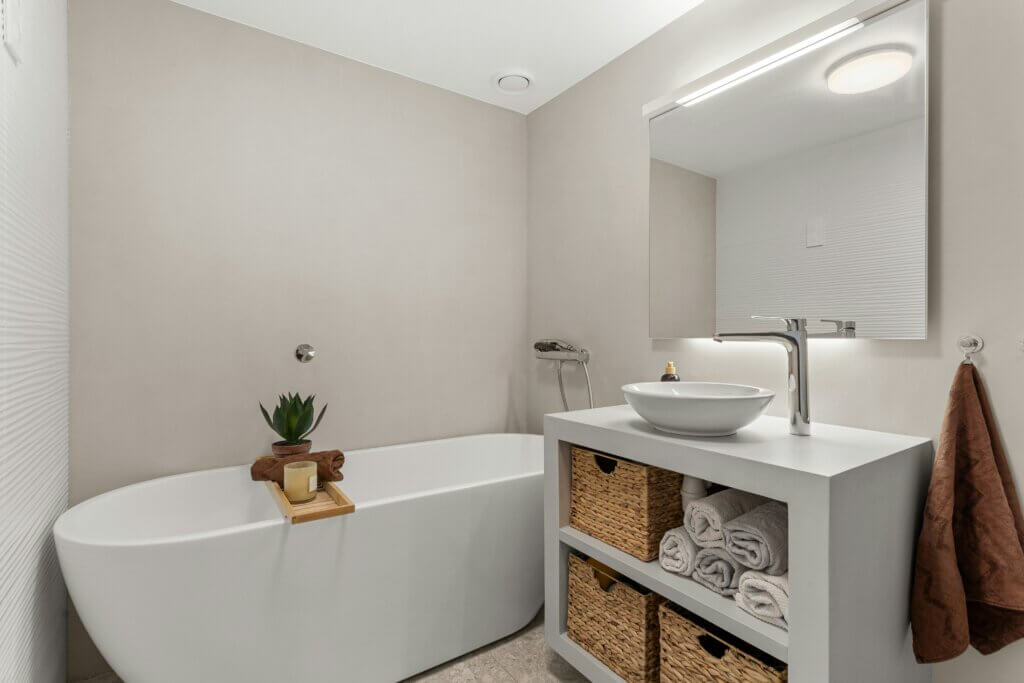
Even in small bathrooms, the mid-century style can be successfully incorporated. That’s because the light colors and colorful accents typical of this style can make small bathrooms appear larger. The fact that the style also features floating vanities or those on slender legs is another advantage for small bathrooms. The same goes for the preference for glass, whether as shelves or as a shower enclosure.
Open vanities or shelves are typical of the mid-century style and create a sense of lightness—which makes sense, especially in small bathrooms.
What lights and mirrors go well with a mid-century bathroom?
When selecting lamps and lights, follow the principles of mid-century style and choose those with softly curved shapes. Wall sconces with opal glass or a color-coordinated pendant light add the finishing touch to your bathroom.
The same goes for mirrors, which don’t have to be just round or oval—they can also be asymmetrical. Delicate frames made of wood or metal add the finishing touch.
What’s the difference between a Mid-Century and a retro bathroom?
In principle, there is no difference; rather, the mid-century style falls under the umbrella of “retro.” This is because “retro” refers to furniture, accessories, and the like that, while inspired by the styles of bygone eras, have nevertheless been modernized at least a little.
How much does a Mid-Century-style bathroom renovation cost?
How much you’ll need to spend on a Mid-Century-style bathroom renovation depends primarily on the amount of work involved. You might be able to achieve a mid-century look in your bathroom simply by adding new towels and a few accessories—in which case, the costs will remain reasonable. However, if you’re removing old tiles and replacing them with new ones and/or purchasing new bathroom furniture and fixtures, the renovation can get expensive.
Good to know:
There is no exact definition of the time period covered by the Mid-Century style. Some authors limit it to the 1940s through the 1950s, while others include at least the early 1970s as well.
Among the best-known representatives of the Mid-Century style are Charles and Ray Eames, Harry Bertoia, Arne Jacobsen, and George Nelson.
Seamless, minimalist, and surprisingly versatile: microcement has evolved from a minimalist architectural material into a popular alternative to traditional tiles. Interior designer Stefanie Winter explains where microcement can be used in the bathroom, what’s important when it comes to installation and waterproofing—and why the seemingly uncomplicated surface is best left to the professionals. Microcement is …
Elevation over heat, water security over drought stress, nature over paved surfaces: Climate change is increasingly reshaping the criteria for high-end real estate. The renowned Austrian platform for luxury real estate, PREMIUM-LIVING.COM, highlights which regions in Austria are benefiting, which international markets are becoming particularly interesting—and why the definition of luxury is changing at the …
Peace, seclusion, and nature are becoming the most precious assets of our time. LUXGUT is one of the pioneers of “Forest Living”: Long before the term became a housing trend, living in harmony with the forest was at the heart of what we do. With VICTORIA, this idea is now being taken to a new …
SIE WOLLENNICHTSMEHR VERPASSEN?
Unser kostenloser Newsletter liefert Ihnen wöchentlich die neuesten Artikel rund ums Wohnen & Leben.
SIE WOLLENNICHTSMEHR VERPASSEN?
Unser kostenloser Newsletter liefert Ihnen wöchentlich die neuesten Artikel rund ums Wohnen & Leben.
SIE WOLLEN
NICHTS MEHR VERPASSEN?
Unser kostenloser Newsletter liefert Ihnen wöchentlich die neuesten Artikel rund ums Wohnen & Leben.