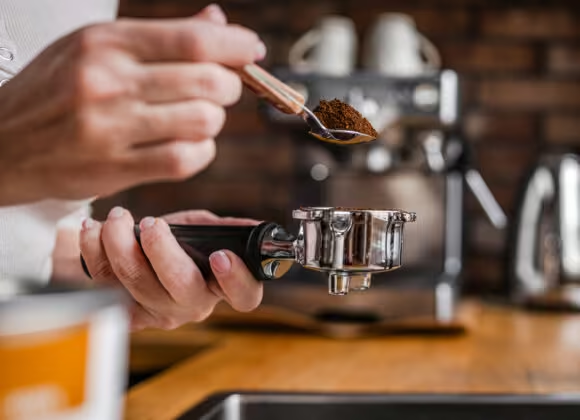

There are those dishes that are like a well-tailored coat: uncomplicated, versatile, reliable – and yet with style. One-pot dishes belong exactly in this category. They are the culinary answer to our everyday lives, which have become faster, but no less demanding. We want flavor, satiety, nutrients – and less chaos in the kitchen, please. At the same time, one-pot recipes celebrate something very old: cooking in a vessel in which flavors don’t just add up, but meld together.
A bit of history: from the hearth fire to cast iron love
You could say that one-pot is not a trend, but the oldest cooking technique in the world. Long before kitchens had stores full of special appliances, pots were placed over an open fire. In almost all cultures, stews, ragouts, soups and stews were what we now call “everyday cooking”: nourishing, filling and efficient – and often also what kept families together because it brought everyone to the table.
Such dishes are also deeply rooted in Austria. A hearty goulash, a lentil stew or Krautfleckerln – the latter is strictly speaking more of a one-pan, but absolutely one-pot at heart – are just as much a part of it as classic beef, which slowly simmers away with roots and leaves the whole room smelling of Sunday. Italy, on the other hand, celebrates cooking in a pot with minestrone or pasta e fagioli, in which beans, pasta and aromatic tomatoes merge into a down-to-earth feel-good dish.
In France, it is opulent classics such as cassoulet or boeuf bourguignon where time and patience are the real spice. In Spain, paella is an iconic one-pot dish that, despite its simplicity, has an entire culinary culture behind it. And in North Africa, the tajine is a true one-pot wonder: a vessel with a lid that carefully captures aromas and condenses spices such as cinnamon, cumin or saffron into a kind of fragrant poem.
The common denominator of all these dishes is always the same: a pot that turns individual ingredients into a whole. And that is precisely what makes one-pot dishes so timelessly attractive to this day.
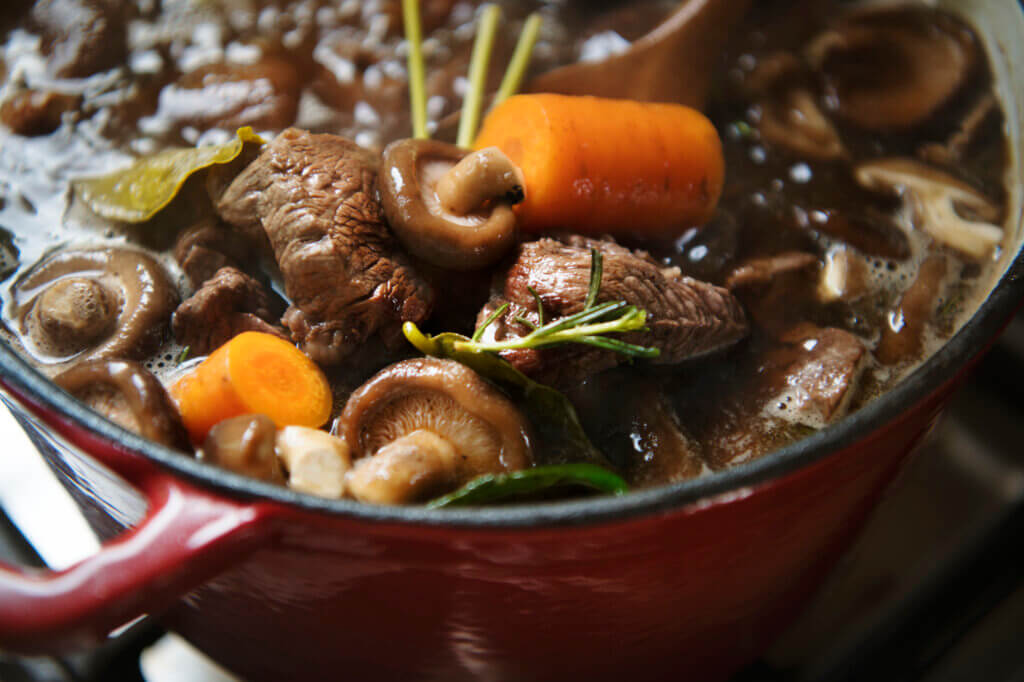
4 reasons why One-Pot is booming right now
1) Flavor through “flavor stacks”
A special magic happens in a pot: roasted aromas from frying combine with liquid, starch and spices. Rice, pasta or potatoes soak up soup, wine, tomato, butter or coconut milk – and become flavor carriers themselves.
2) Fewer dishes, less time, less stress
One-Pot is the anti-overload kitchen. Instead of five pots, bowls, sieves and pans: one pot, one wooden spoon, a clear dramaturgy. And in the end: a kitchen that smells like home – not like washing up.
3) One-pot recipes are perfect for meal prep and cooking leftovers
One-pot dishes are brilliant if you:
- wants to pre-cook for 2-3 days
- Want to use vegetable and herb scraps
- wants to cook cheaply (pulses, rice, seasonal vegetables)
- would like to calculate very well per portion
4) A pot can also be “design”
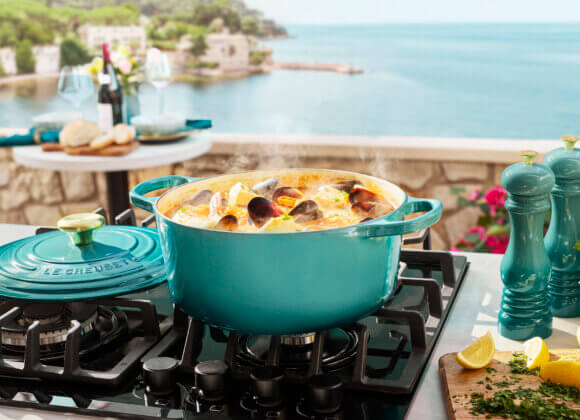
A beautiful one-pot dish is not just food, but also table culture. Cast iron, enamel, heavy pots with patina – you cook, serve and eat from them. This is “less is more” in a culinary way.
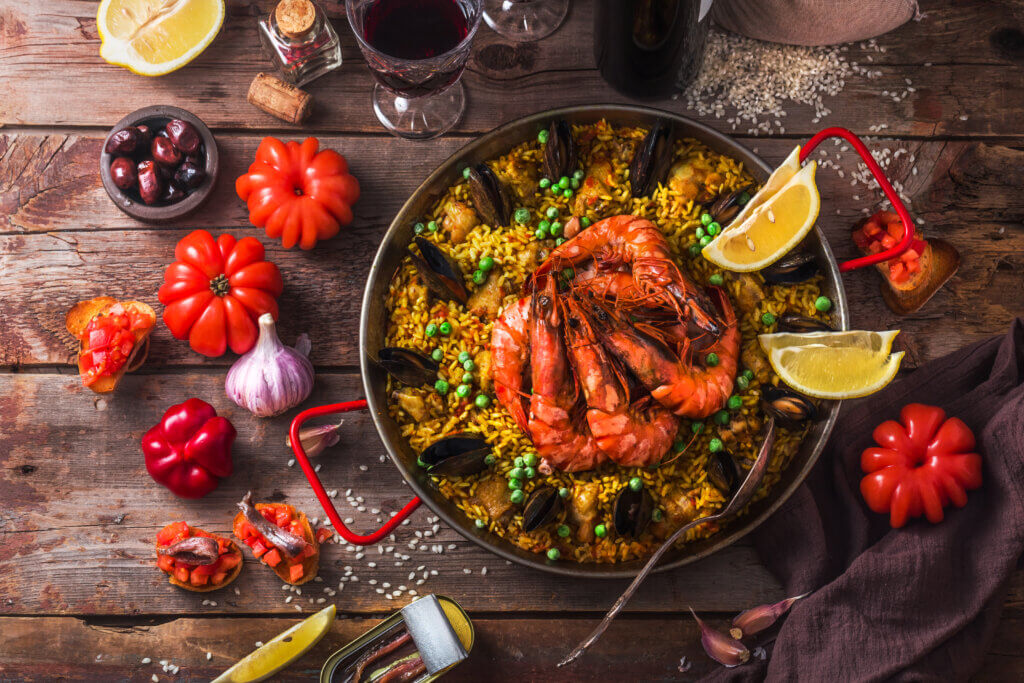
Small one-pot rules (so that it really works)
- Sauté first: onion, garlic, meat or mushrooms – roasted flavors are the basic tone.
- Dose correctly: Pasta and rice need more liquid than you think because they absorb it.
- Finally, season to taste: acid (lemon/vinegar), salt, fresh herbs and a little fat (butter/olive oil) turn “good” into “wow”.
- Give it time: A one-pot requires less effort, but often a few minutes’ rest – so that everything sets. For some dishes (goulash, chili, etc.), it is also worth preparing them the day before.
Have we whetted your appetite? That’s good! Because let’s continue with three delicious recipes.
Creamy one-pot orzo with lemon chicken, spinach & parmesan
A dish like an evening in a small bistro: soft, creamy, fresh and surprisingly uncomplicated.
Ingredients (for 4 portions)
- 2 tbsp olive oil
- 1 onion, finely diced
- 2 cloves of garlic, finely chopped
- 450-500 g chicken breast or boneless chicken thigh, cut into pieces
- 300 g orzo (kritharaki, rice noodles)
- 800 ml chicken or vegetable stock
- 150 ml whipped cream
- 2 handfuls of fresh baby spinach
- 1 organic lemon (zest + juice)
- 60-80 g Parmesan cheese, freshly grated
- Salt, pepper
- Optional: chili flakes, fresh basil or parsley
Preparation
- Heat the olive oil in a large pan. Fry the chicken pieces well, season with salt and pepper. Remove briefly.
- Sweat the onion and garlic in the same pan until translucent (add 1 tbsp oil if necessary).
- Stir in the orzo and fry for 1 minute.
- Add the stock and cream, stir well and bring to the boil.
- Return the chicken to the pan, reduce the heat and simmer for 10 to 12 minutes, stirring frequently – orzo tends to stick.
- Fold in the spinach until it collapses. Add the lemon zest and a little juice.
- Stir in the parmesan and season to taste. If you like, sprinkle with chili and fresh herbs.
MyHome tip
- For more elegance: a dash of white wine to deglaze before the stock.
- For a “winter version”: green chard instead of spinach, served with roasted pine nuts.
- For guests: serve with lemon zest and parmesan flakes – it immediately looks like a “restaurant”.
One-pot lentil Bolognese (vegetarian) with tomato, carrot & herbs
The perfect comfort food for anyone who loves pasta – but wants something more nutritious. Tastes even better the next day.
Ingredients (for 4-5 portions)
- 2 tbsp olive oil
- 1 large onion, finely diced
- 2 cloves of garlic, chopped
- 2 carrots, finely diced
- 1 stalk of celery, finely diced (optional, but great)
- 200 g red lentils
- 2 tbsp tomato puree
- 1 tin of chunky tomatoes (400 g)
- 700 ml vegetable stock
- 1 teaspoon oregano
- 1 teaspoon thyme
- 1 bay leaf
- 1-2 tbsp balsamic vinegar (or 1 tsp sugar + 1 tbsp lemon juice)
- Salt, pepper
- Optional: 1 pinch of cinnamon or smoked paprika powder
- To serve: Parmesan or pecorino, basil, pasta or polenta
Preparation
- Heat the oil and sauté the onion, carrot and celery for 5 minutes.
- Add the garlic and tomato purée, roast for 1 minute (this is the secret to depth!).
- Stir in the lentils, add the tomatoes, stock and spices.
- Bring everything to the boil, then simmer gently for 15 to 18 minutes until the lentils are soft.
- Season to taste with balsamic vinegar, salt and pepper. Remove the bay leaf.
- If you want it “saucier”: blend part of it briefly with a hand blender.
MyHome tip
- This bolognese is a meal-prep star: it keeps for 3 days in the fridge and is easy to freeze.
- For the “dinner party” version: place on creamy polenta, top with parmesan and herbs.
MYHOME recipe: Caponata alla Mamma Pina
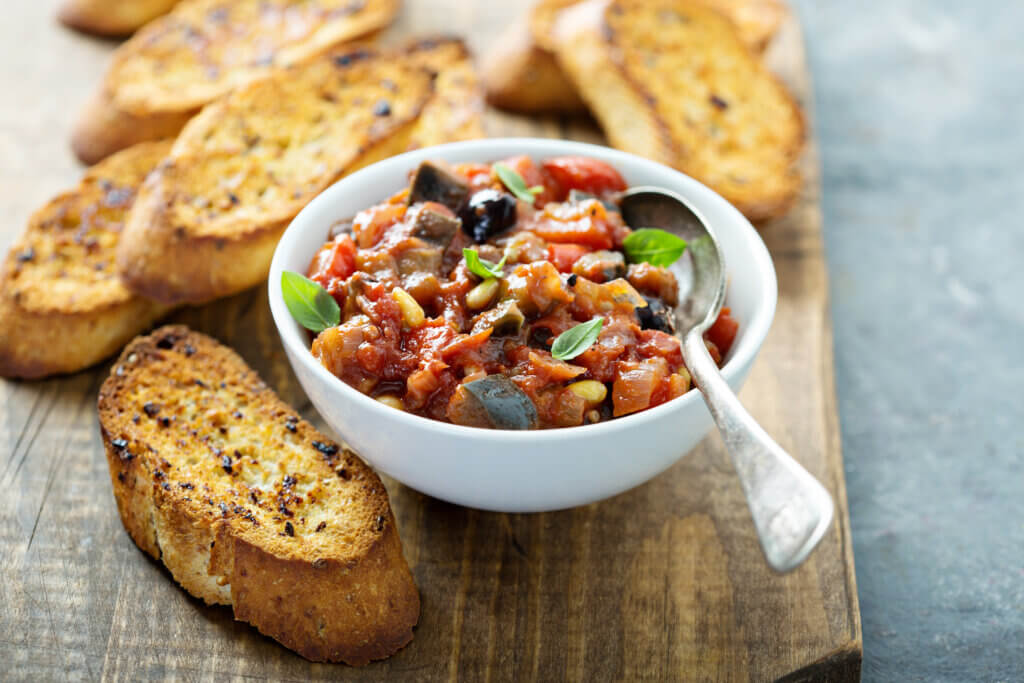
Strictly speaking, Sicilian caponata is a borderline case because the different ingredients have to be roasted, steamed and fried in different pans. But the MYHOME editors say – this classic dish from the south is simply too good to keep from you. This version serves 6 people as a starter and 3-4 as a main course (with bread).
Ingredients
- 3 red peppers
- 2 carrots
- 5 small potatoes
- ½ stalk of celery
- ½ large onion
- 1 eggplant
- 10 green olives (pitted)
- 3 tbsp capers
- 2-3 tbsp pine nuts (to taste)
- approx. 600 g tomato sauce (more/less depending on the amount of vegetables)
- Balsamic vinegar (or creamy balsamic vinegar)
- 1 tsp honey
- Basil to decorate
- Olive oil + sunflower oil (for frying)
- Salt
Preparation (10-15 minutes)
- Chop the vegetables:
Cut the carrots, potatoes, celery and peppers into small pieces (dice). Finely dice the onion. Cut the olives into slices. - Blanch the celeriac:
Blanch the celeriac in boiling water for 5 minutes, then strain and set aside. - Soak the peppers:
Place the peppers in cold salted water for approx. 30 minutes. This takes away some of the bitterness and makes them milder. - Prepare the eggplants:
Slice the eggplant, season with salt and leave to soak in water for 5 minutes. Then pat dry and cut into cubes.
Preparation (approx. 40-45 minutes)
- Fry the potato cubes in olive oil until they are soft and have a light roasted aroma. Remove and place in a large bowl.
- Fry the carrots in a little oil. As soon as they are softer but still slightly firm to the bite, add the diced onion and fry until translucent. Stir in the capers and olives (sliced) towards the end. Add this mixture to the bowl with the potatoes.
- Fry the diced eggplant in sunflower oil until golden brown on all sides.
- Drain the peppers, pat dry and gently fry in a little olive oil until they are soft but not falling apart.
- Toast the pine nuts in a dry pan until fragrant and lightly colored. Set aside.
- Place all the vegetables in a large casserole dish with a small dash of olive oil (cast iron, because it keeps warm for longer and the flavors can meld better) and leave to infuse for 5 minutes over a low heat. Then add the tomato sauce and half the pine nuts and mix everything well.
- In a small bowl, mix the balsamic vinegar with 1 teaspoon of honey (alternatively, use creamy balsamic vinegar). Pour into the pan, mix well and leave to infuse briefly.
- Remove the pan from the heat and only add salt when the caponata is only lukewarm. This keeps the vegetables aromatic and the acidity “round”, not harsh.
- Serve the caponata lukewarm or at room temperature. Garnish with the remaining pine nuts and basil leaves top.
One-pot dishes are not a makeshift solution – they are a kind of kitchen poetry: ingredients that don’t exist next to each other, but with each other. In the end, this is exactly what we are often looking for in our everyday lives: a little order, a little warmth – and a taste that sounds like “everything is good”.
Related posts:
Winter moments of indulgence – brunch ideas and winter recipes
Soup Day – the oldest comfort food in the world
Snackification: mini meals on trend


![Christoph_Krauli_Held©Monika_Loeff_19285[1]](https://myhome.at/wp-content/uploads/2025/09/Christoph_Krauli_Held©Monika_Loeff_192851-580x420.jpg "Home cooking reloaded incl. competition")