
Winter 2025 has brought forth a new style icon that is not only inspiring the catwalks of Paris and New York, but also our streets, parks and Instagram feeds: the balaclava is not just any old hat, it is THE statement accessory of the season. What used to be associated with outdoor sports, skiing vacations or even criminal acts is now the knitted alternative to the classic beanie, which covers the head, neck and often parts of the face in a warm, stylish dress and opens up a whole new world of styling. At the end of the article you will find a free balaclava knitting pattern.
The balaclava has an astonishingly long and varied history: the name itself dates back to the Crimean War in the mid-19th century, more precisely to the Battle of Balaklava, where British soldiers wore knitted hoods to protect themselves against the bitterly cold winters. These early versions were already similar to what we know today: a tightly knitted piece that protects the head and neck, leaving only parts of the face exposed.
In the fashion world, the balaclava has long been merely a functional item of clothing – popular with winter sports enthusiasts, motorcyclists and outdoor fans. But in recent years, the image has changed radically: Leading fashion houses such as Gucci and Balenciaga showed balaclavas on the catwalks, elevating them from a purely protective utility item to an it-piece of the street and high-fashion look. This winter, the trend has continued to grow: catwalk, streetwear and influencer culture have made the accessory ubiquitous. And now the balaclava is not only considered the “warmest headwear” of the season, but also a fashion statement that challenges classic winter accessories such as hats and scarves.
Why everyone wants to wear a balaclava now
What makes this piece of fabric so irresistible? There are several reasons:
1. function meets statement: in winter, the balaclava not only replaces a beanie and scarf in one, it immediately gives the outfit a silhouette with a strong character – from a minimalist tone-on-tone look to a streetwear combination rich in contrasting colors.
2. versatility: depending on the design, it can completely enclose the face, head and neck or only leave parts of it exposed. Modern versions can even be worn as a loop or hood – the balaclava is a real chameleon among accessories.
3. comfort & warmth: Especially in regions with long, cold winters, the balaclava-like headgear is a practical companion that protects against wind, cold and sometimes even snow – an aspect that makes it absolutely convincing in functional terms.
4. fashion culture and social media: Influencers, celebrities and street-style photography are helping to ensure that the balaclava is no longer just protective clothing, but is becoming a trend signal.
Wool, yarn and material: what is best?
The choice of material also plays a major role when knitting your own garments – not only for warmth, but also for drape, comfort and look:
– Chunky knit natural wool:
Thick, bulky yarn (e.g. merino or alpaca mix) provides cozy warmth and a structured, urban look – perfect for winter outfits.
– Fine blended fibers with luxury fibers:
qualities with yak, cashmere or fine merino wool result in a softer, more luxurious look that feels pleasant on the skin – especially when you wear the balaclava directly on your face
– Multi-thread knitting:
A combination of different yarns (e.g. a thinner yarn knitted several times) produces a dense yet flexible fabric – ideal if you don’t want a balaclava that is either too heavy or too thick.
Feel like it? You can find free knitting instructions here – and get started right away!
Balaclava in chunky knit – description & free instructions to download
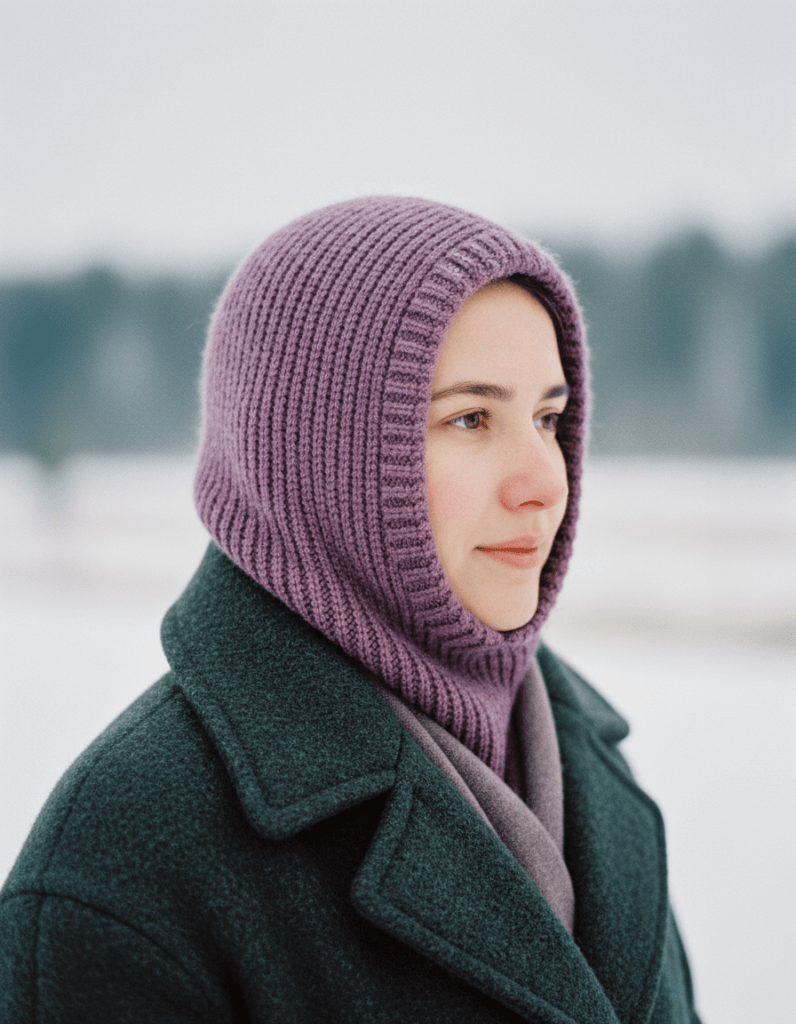
This balaclava is characterized by a minimalist, timeless silhouette. A wide-cut neckband ensures a comfortable fit, while the head section fits softly and snugly. It is worked from the bottom up: First the model is created in closed rounds, then the upper section is knitted in rows. The characteristic, voluminous look is created by working several fine yarns at the same time.
👉 Download Balaclava knitting pattern
Dimensions
- Width of the neckband: approx. 32 cm when unstretched
- Total height: approx. 36 cm
Mesh sample
- 10 × 10 cm: 11 stitches × 17 rows
Note: Especially when knitting with multiple threads, it is advisable to make a stitch sample before starting in order to ensure the best possible fit and stitch pattern.
Material required
- Circular knitting needle 8 mm, optionally with 30 cm cable length or worked with the Magic Loop method
- Yarn according to personal preference, approx. 100-150 g in total, depending on running length and number of threads
(in the example shown: Cariaggi Angora in Amethyst, approx. 90 g, worked in three threads) - Scissors
- Measuring tape
- Wool or crochet hook
Let’s go!
Collar
- Cast on 68 stitches with the 8 mm circular needle, threading the yarn.
- Close the stitches for the round and mark the beginning of the round.
- Knit over a height of 2.5 cm in the rib pattern in rounds
(alternating 1 knit stitch, 1 purl stitch).
Headboard
- Then continue working in rounds in stockinette stitch.
- Decrease 4 stitches evenly over a total length of 10 cm.
- At a total height of 12 cm, decrease another 8 stitches evenly.
- After a total length of 16 cm, bind off 10 elastic stitches – this area will later form the face opening.
Back section
- Nun wird nicht mehr in Runden, sondern in Reihen weitergearbeitet:
- Back row: all stitches knit
- Back row: purl all stitches
- Continue until a total length of about 40 cm is reached.
Closing the head mold
- Distribute the remaining stitches evenly over two circular knitting needles.
- Turn the work to the wrong side.
- Fasten off all stitches elastically so that the back of the balaclava is closed.
Ribbed cuffs at the face opening
- Pick up approx. 58-68 stitches along the opening with the crochet hook.
Make sure the number of stitches is even. - Distribute the stitches on the circular needle and work in rounds in rib pattern
(knit 1 stitch, purl 1 stitch). - After 6 cm cuff height, fasten off all stitches elastically.
- Fold the cuff inwards and sew it on carefully by hand using a wool needle.
Completion & care
- Sew or weave in all threads neatly.
For a beautiful finish, we recommend a gentle hand wash with a special wool detergent. Then carefully pull the balaclava into shape and leave to dry flat.
Related posts:
Sophie Scarf – free tutorial for the trendy scarf